The best event gamification ideas share one trait: they give attendees a simple reason to do something the organizer already wants, such as visiting booths, attending sessions, meeting people or sharing their details. Scavenger hunts, trivia, QR missions, leaderboards and prize drawings all do this well when they are tied to a goal and run from the same registration record. rsvpBOOK has supported event organizers since 2004, and its gamification tools cover these formats for conferences, trade shows and career fairs.
This guide walks through ideas by event goal, what each one needs, how to keep costs low and how to tell whether it worked.
TL;DR
- Pick the behavior first (booth visits, session attendance, networking, lead capture), then choose the game that rewards it.
- Scavenger hunts, trivia, QR missions and prize drawings are the most practical formats for in-person events.
- Keep mechanics minimal and promote the game before the event starts.
- Low-cost gamification can still lift participation: one academic study saw opt-in rise to 56% with a QR-code game and a leaderboard.
- Measure participation, engagement and outcomes against the goal you set at the start.
Table of Contents
- Start with the behavior, not the game
- Gamification ideas by event goal
- What each idea needs
- Low-cost ideas that still work
- Promote it before the event
- Plan for everyone in the room
- How to tell whether it worked
- Trends worth using in 2026
- Where rsvpBOOK fits
- Perspective
- FAQ
- Ready to gamify your next event?
- Sources
Start with the behavior, not the game
Most gamification fails because it starts with a format (“let’s do a leaderboard”) instead of a result. A better order:
- Name the one or two behaviors you want. Examples: more booth visits, fuller morning sessions, more attendee-to-attendee introductions, more qualified leads for exhibitors.
- Choose a reward that fits the audience. Status, recognition and a good prize usually beat generic swag.
- Pick the lightest mechanic that closes the loop: the attendee acts, sees a result right away and wants to act again.
That last point has research behind it. A 2013 ACM paper on designing events as gameful experiences found that people at events are motivated by entertainment more than by problem-solving. Its authors recommend prioritizing fun and using only the minimum game mechanics needed to give feedback with little friction.
In practice: one clear action, one visible score, one prize moment.
Gamification ideas by event goal
Drive booth traffic at trade shows
Trade shows are where gamification pays off fastest, because exhibitors want conversations and organizers want sponsors who renew.
- Booth passport or scavenger hunt. Attendees collect scans at a set number of booths to enter a drawing. Each scan is a recorded visit, so exhibitors and organizers get real traffic data.
- Instant Prize Wheel. A spin at the booth turns a scan into a quick, visible moment. The attendee shares details, spins and walks away with something, while the exhibitor gets a qualified lead.
- Live Winner Drawing. Entries collected through the day are drawn on a big screen at a set time. The scheduled drawing pulls attendees back to the show floor and gives sponsors a stage.
- Exhibitor challenges. Points for each booth visit let sponsors run their own raffles and competitions on top of the show-wide game.
rsvpBOOK offers exhibitor and organizer lead retrieval alongside booth giveaways, so a visit, a scan and a prize entry live in one record instead of three spreadsheets. Standalone booth giveaway tools start at $99 per event, for exhibitors or organizers who only need the prize piece.
Fill sessions and workshops
Training managers and CE providers care less about booth visits and more about attendance and completion.
- Session streaks. Award points for attending sessions in a track, then a bonus for finishing the track.
- Trivia at the start or end of a session. A short quiz on the content primes attention and shows what stuck.
- Workshop challenges. Small-group tasks with a team score work well in training rooms, especially when workshop assignments are already set at registration.
Sessions with CE credits benefit from this pairing: the same attendance record that feeds the game can support credit tracking. rsvpBOOK handles sessions and workshops, including CE credits, as part of the same registration.
Get people talking to each other
Networking is hard to force. Games give strangers something to talk about.
- Human bingo. Each square is a trait or experience; attendees find someone who matches. It needs a printed card or a phone and nothing else.
- Team scavenger hunts. Mixed teams of five to eight keep groups small enough that everyone participates. Craft Party’s large-group games guide suggests splitting crowds of more than 20 into teams of that size.
- Connection points. Points for meeting a set number of new people, confirmed by a QR scan of each other’s badge or code.
Boost engagement for marketing and brand events
Marketing teams usually want attention and shareable moments.
- Photo missions. Attendees complete a set of photo challenges around the venue.
- Social challenges. Points for posting with an event hashtag.
- Big-screen prize drawings. A live drawing on the main stage ties the audience together and gives sponsors a visible moment.
Personal touches can matter more than expensive ones. The Association Event Design Playbook 2026 argues that status does not require budget, and gives the example of a $2 exclusive sticker with the right message outperforming a $40 water bottle.
Capture candidates at career fairs
For campus recruiters and career fair hosts, the goal is candidate capture and booth traffic.
- Prize wheel at the recruiting table. A spin in exchange for scanning in gives recruiters a contact record for each student who stops.
- Employer passport. Students collect scans from a number of employers for a drawing, which spreads traffic beyond the biggest names.
- Timed drawings. A live drawing at set times keeps the floor busy during slower hours.
rsvpBOOK booth giveaways are also used by recruiting teams at career fairs, so the same prize wheel and winner drawing apply.
What each idea needs
A quick comparison helps with planning. Needs vary by format: in-person events rely on phones and signage, virtual events on an event app or site, and hybrid events on both.
| Idea | Best for | In-person | Virtual or hybrid | Main requirement |
|---|---|---|---|---|
| Scavenger hunt | Traffic, networking | QR codes at stops | Tasks in an app or event site | Clear list of tasks and a prize |
| Trivia | Sessions, main stage | Big screen and phones | Live poll or quiz in session | Questions tied to content |
| Prize wheel | Booth leads | A booth and a scan | Not suited | A scan or entry first |
| Winner drawing | Sponsor visibility | Big-screen moment | Streamed announcement | Entries collected in advance |
| Points and leaderboard | Multi-day events | Visible screen | In-app ranking | Rules that are easy to read |
| Photo or social mission | Brand events | Phone camera | Upload or hashtag | Moderation plan |
In-person gamification is typically the easiest to start, because QR codes and smartphones do most of the work. rsvpBOOK’s QR check-in works on any smartphone, and its QR code management module can generate codes for stops, booths and sessions.
Low-cost ideas that still work
Not every event has a gamification budget. These formats need little more than planning:
- Lightning scavenger hunt. TeamBuilding.com lists a Lightning Scavenger Hunt as free, about five minutes, for groups of 5 to 100 or more, using items already in the room.
- QR missions. The ACM paper above studied a low-tech game arcade built on QR codes, with points for posting ideas, commenting, liking and meeting other attendees, plus a leaderboard. Opt-in reached 56% (70 of 125 attendees), against 15% at comparable earlier events. The top five players, 7% of participants, earned 70% of the points, a reminder that a small group of enthusiasts drives much of the activity.
- Meaningful, cheap rewards. Recognition, early access or a small exclusive item can go a long way, as the sticker example above shows.
The practical lesson: effort goes into design and promotion, not spending.
Promote it before the event
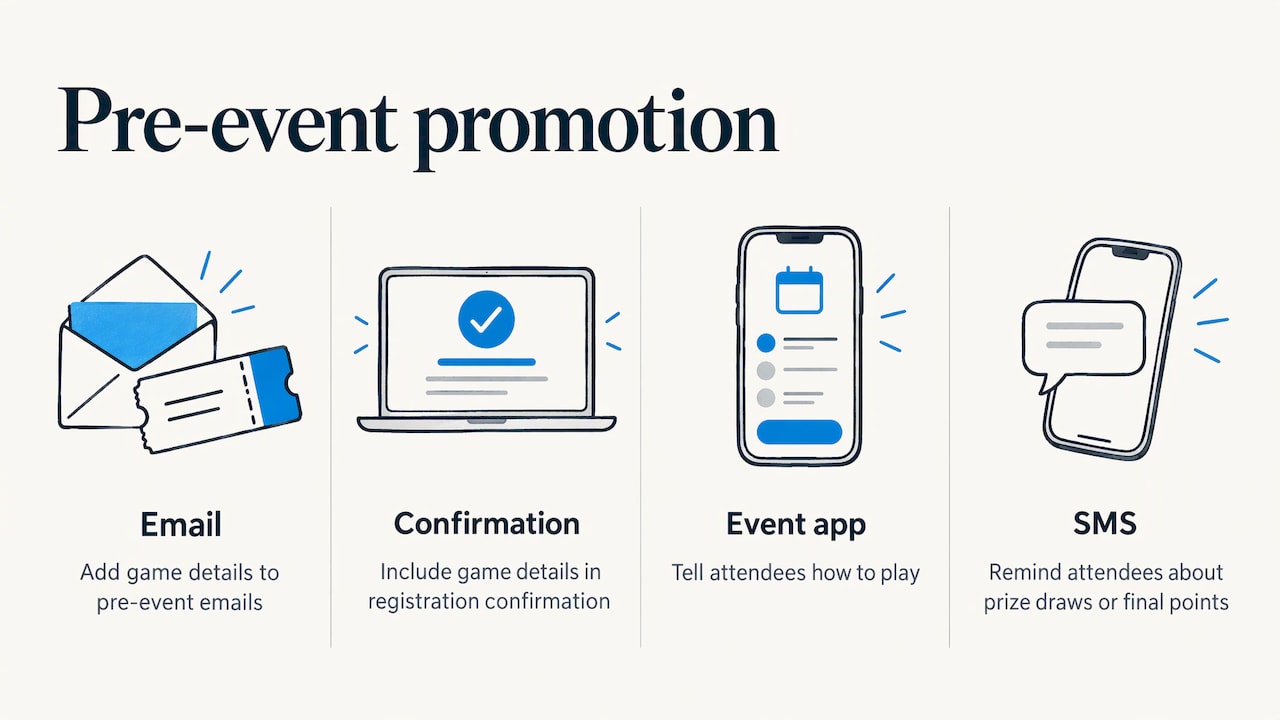
A game nobody knows about does not change behavior. Add it to the pre-event emails, the registration confirmation and the event app so attendees arrive knowing how to play. SMS reminders are a natural fit for a prize drawing time or the last chance to earn points.
It also helps to hold back some of the excitement. NACE’s guidance on gamification for in-person events suggests not opening scoring and leaderboards until close to the start, so late arrivals are not put off by runaway scores.
Plan for everyone in the room
The same NACE guidance offers a few practical safeguards:
- Test any gamification app on both iOS and Android before committing.
- Keep a paper backup for attendees who do not have a phone or prefer not to use it.
- Make the rules short enough to explain in a sentence.
Add to that: set a cap on how many prizes one person can win, publish the drawing rules, and decide in advance how ties are handled. Clear rules keep the game fun and keep sponsors comfortable.
How to tell whether it worked
Decide on the measures before the event, and tie each one to the behavior you picked at the start.
- Participation: how many attendees joined the game, out of those registered. The ACM study above used opt-in rate for exactly this.
- Engagement: booth scans, session check-ins, quiz responses, points earned, where people dropped off. The Council for Science’s online conference planning guide lists measures such as poll responses, breakout attendance and drop-off points.
- Outcome: a short exit poll and a follow-up survey. The same guide suggests a two-minute exit poll and a six-week follow-up of five questions or fewer.
For a sense of what results can look like, a peer-reviewed 2025 study in Smart Learning Environments of a virtual student conference reported participation rising from 240 to 759 after gamification was added. In a survey of 77 participants, 76.6% were very satisfied and 87.7% agreed that it improved social interaction. The authors also point out that gamification works alongside other digital strategies, not on its own. For ideas on tracking engagement more broadly, see this overview of audience engagement strategies.
One caution on reading your own numbers: a leaderboard dominated by a few players, as in the ACM study, is normal. Look at the median participant and at total scans, not only the top of the board.
Trends worth using in 2026
Trends come and go, but a few practical ones fit U.S. events of any size:
- Phone-first participation. QR codes and mobile agendas let attendees join without installing anything extra.
- Real-time prize moments. Instant wheels and live drawings give immediate feedback.
- Connected data. Scans, sessions and registration in one record make results easier to report.
- Sponsor-ready activations. Booth challenges give exhibitors a measurable return.
The flashier ideas, such as virtual worlds or wearable sensors, need more budget and more attendee onboarding. For most planners, a simple, well-promoted scavenger hunt or booth drawing delivers more.
Where rsvpBOOK fits
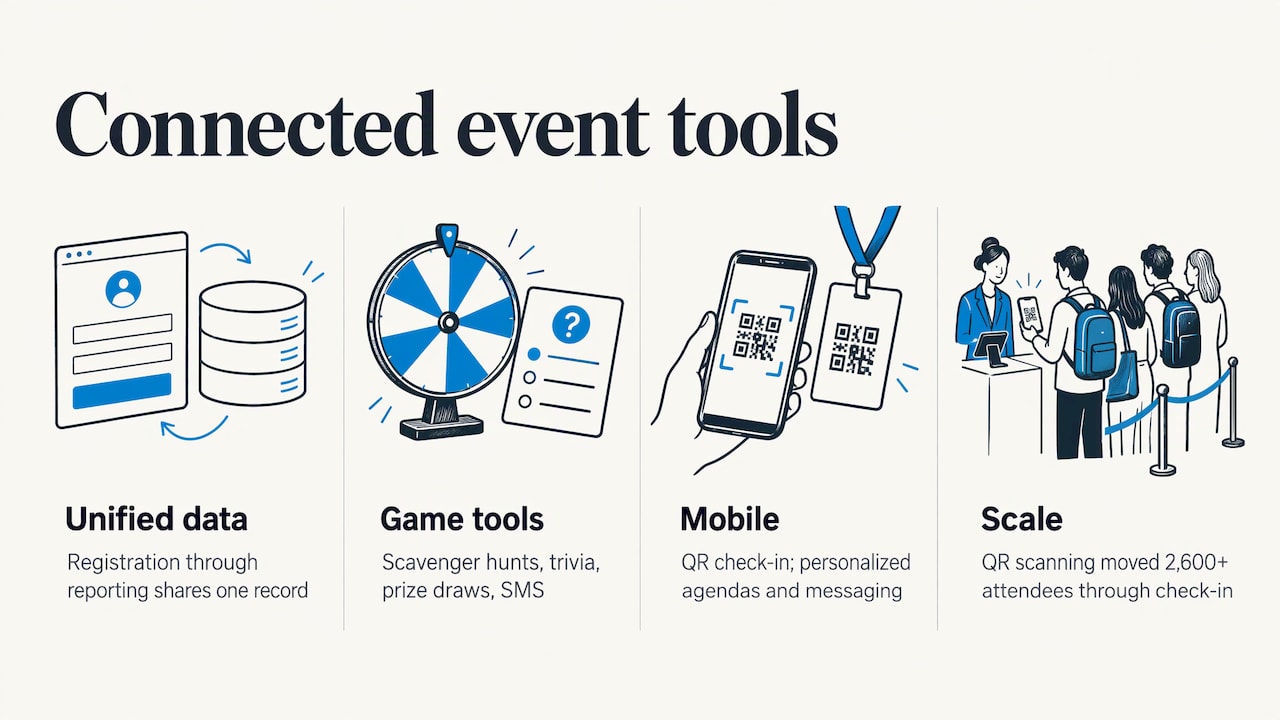
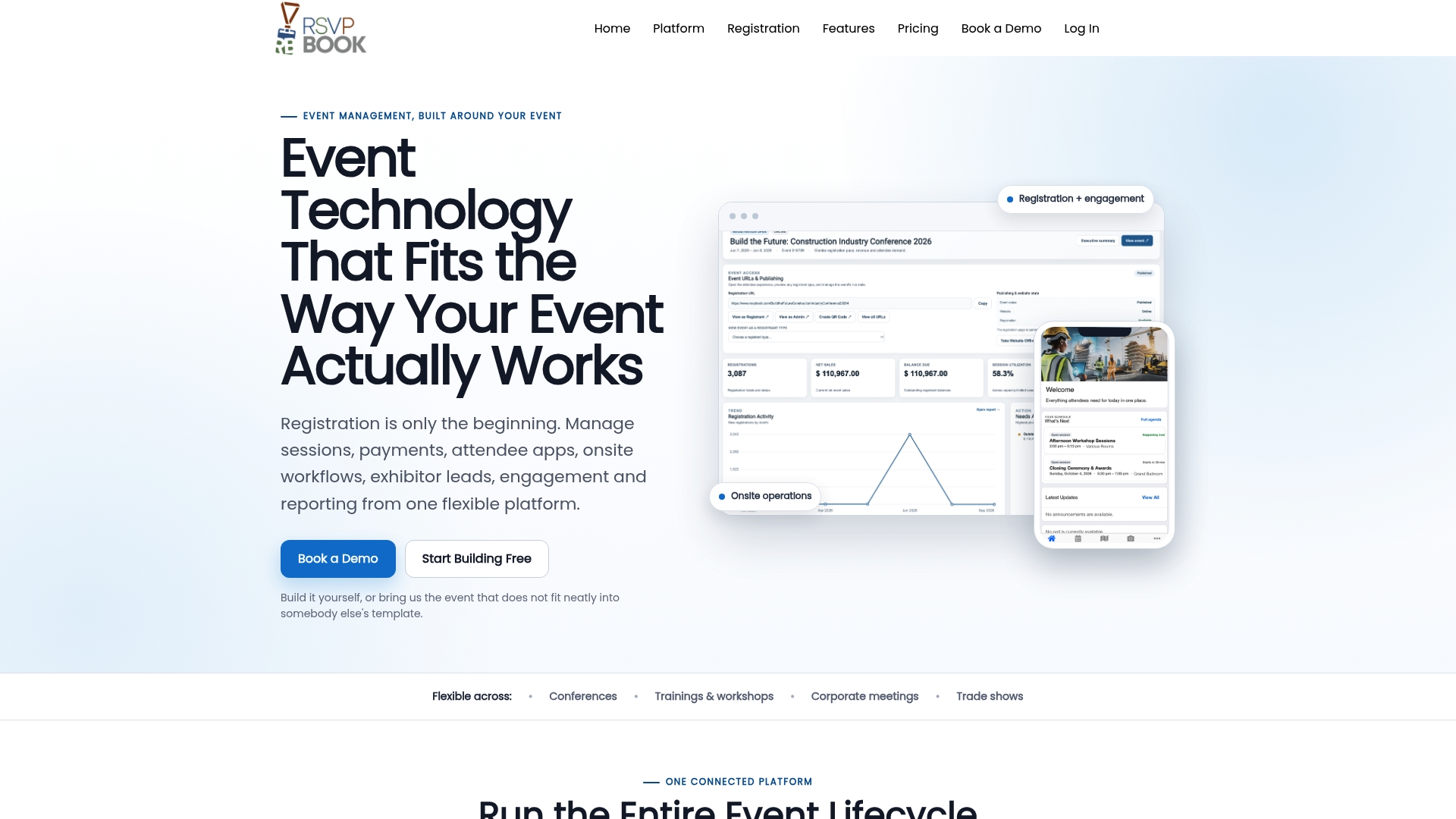
Gamification works best when it is not a separate system. rsvpBOOK connects registration, payments, sessions, onsite operations, exhibitor programs, engagement and reporting in one record, so a scavenger hunt, a trivia round or a prize drawing draws on the same attendee data as everything else.
The engagement tools include gamification, scavenger hunts, trivia, big-screen prize drawings and SMS reminders, backed by custom reports and automated alerts. Onsite, QR check-in works on any smartphone, and the mobile attendee app offers personalized agendas and messaging. Badge printing and check-in kiosk hardware are optional add-on rentals.
Pricing is per registration, with discounted rates for nonprofits and government organizations. Organizers can set events up on their own or use hands-on implementation support. Details on modules are on the pricing page.
rsvpBOOK is also a flexible alternative to enterprise event platforms, built for complex events without enterprise complexity.
One customer moved 2,600+ attendees through check-in with QR scanning, which shows the same scanning approach scales from a booth game to a full event floor.
Perspective
Since 2004 we have watched the same pattern: gamification that is bolted on at the end looks like a gimmick, and gamification built into registration looks like part of the event.
That is why we keep the game, the badge scan, the session record and the report in one place. A scan at a booth is a lead for the exhibitor, a point for the attendee and a data point for the organizer, all from a single action.
Our advice to planners is to start small. Choose one behavior, one game and one prize moment. A prize wheel at the booth or a live winner drawing on the big screen can be set up quickly, and the results show up in the reports the same day. Once that works, add a scavenger hunt or trivia round.
And if the event is complex, with sessions, CE credits, exhibitors and hotel blocks, we offer hands-on implementation support so the game fits the event design rather than the other way round.
Droshawn
FAQ
What are the easiest gamification ideas to start with?
Scavenger hunts, trivia and a booth prize drawing are the simplest. Each uses attendees’ own phones, a few QR codes and a clear prize. Pick one behavior to reward and keep the rules to a sentence.
How do I add gamification to an event that has already opened registration?
Announce it by email and SMS, add it to the event app or agenda, and set the start of scoring close to the event. Games that rely on QR scans and a drawing can be added late because they do not change the registration itself.
Can gamification work for nonprofit events on a small budget?
Yes. Free or low-cost formats such as scavenger hunts and QR missions can lift participation, as the ACM study found. rsvpBOOK pricing is per registration, with discounted rates for nonprofits and government organizations.
How do I measure whether gamification improved engagement?
Track participation, engagement (scans, check-ins, responses) and outcomes through a short exit poll and a follow-up survey. Compare against your goal and, where you can, against the same event in a prior year.
Ready to gamify your next event?
See how scavenger hunts, prize wheels and live drawings run from one registration record. Book a demo or start building an event free.
Sources
- Designing Events as Gameful and Playful Experiences (ACM, 2013)
- Association Event Design Playbook 2026
- 30 Large Group Games for Parties and Events
- 30 Office Party Games for Work Events
- Gamification Can Be a Game-Changer for In-Person Events (NACE)
- Planning your online conference (Council for Science)
- Leveling up engagement: gamification’s role (Smart Learning Environments)
Recommended
- Gamification for your conference or event
- Online Event Registration: 7 Tools for a Better Attendee Experience
- Trade Show Giveaway, Prize Wheel & Winner Drawing
Planning an event that doesn’t fit neatly into somebody else’s template? See how rsvpBOOK handles registration, onsite check-in, lead retrieval and engagement in one platform. Book a demo: https://www.rsvpbook.com/book-a-demo