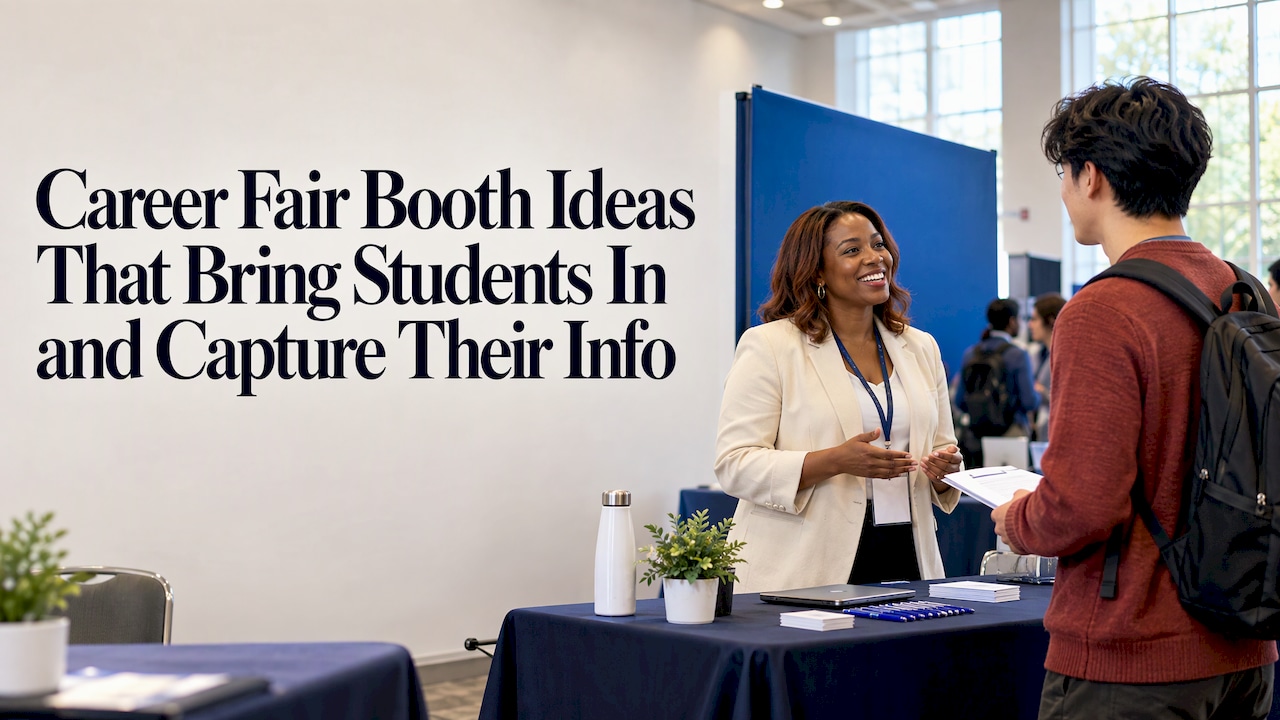
Good career fair booth ideas do two things: give students a reason to stop, and give your team a fast way to record who they are. A short interactive hook, such as a prize spin, plus a phone-based form that asks about major and graduation year works better than a fishbowl of business cards. rsvpBOOK’s Career Fair Giveaway is built for this: students scan a QR code on their own phone, answer your custom recruiting questions, then spin an Instant Prize Wheel or get an entry in an end-of-day Winner Drawing. You get an exportable candidate list.
TL;DR
- Traffic comes from a visible company name, something students can touch or try, and a prize with a clear, quick payoff.
- Candidate data comes from a short form on the student’s own phone, with questions that match your hiring needs (major, graduation year, role interest).
- Staff the booth so there is always someone at the front of the table, and have a second person ready to take overflow.
- Plan the follow-up before the fair. A list you cannot sort or export is a list you will not use.
- rsvpBOOK’s Career Fair Giveaway is priced per event, starting at $99.
Table of Contents
- What a career fair booth has to accomplish
- The basics every booth needs
- Booth ideas that bring students over
- Capturing candidate info without a paper stack
- How the Career Fair Giveaway works
- Trim the budget without losing impact
- A booth checklist for the day before
- Why we build for the follow-up
- Running the whole fair? Here is what rsvpBOOK does
- FAQ
- Ready to try it at your next fair?
- Sources
What a career fair booth has to accomplish
A student walking a large fair sees dozens of banners in an hour. Your booth has a few seconds to say who you are and why stopping is worth it. Then it has a few minutes to turn a chat into a record you can act on.
That gives you three jobs:
- Get noticed. Name, logo and one clear message visible from the aisle.
- Get students talking. A hands-on element, a challenge or a prize.
- Get usable information. Not just a name and email, but the details your recruiters sort by.
Most lists of booth ideas cover the first job and stop. The third job is where fairs are won or lost, because the follow-up happens days later, when nobody remembers the conversation.
The basics every booth needs
Start with the table. Colleges usually provide a standard folding table and chairs, and the details vary. Iowa State’s engineering fair lists an 8’ x 8’ booth with a 6’ draped table, two chairs and two electrical outlets, and says first-time employers commonly bring a logo tablecloth, pop-up banners or backdrops and swag. Other schools differ: Michigan Technological University notes that tablecloths are not provided by default and limits booths to four people. Read your fair’s employer page before you pack.
A reliable core kit, drawn from University of Alaska Fairbanks and MIT guidance:
- A tablecloth that fits the table
- Signage with your company name and logo
- Brochures, flyers and business cards
- Swag or promotional items
- A banner or display screen
- A list of current openings and internships
UAF also warns that power access cannot be guaranteed, so charge devices beforehand. Indiana University South Bend suggests bringing an extension cord, scissors and tape, and keeping displays small enough to sit on or in front of a six-foot table.
Booth ideas that bring students over
Make the name and the message readable from the aisle
Students decide quickly whether to approach. A large banner with your name and the roles you are hiring for does more than a table covered in small print. If you want help with the visual side, this guide on employer branding for stronger teams is a good place to start thinking about consistent signage and messaging.
Put a short line on the banner that names what you want: “Hiring 2027 grads in engineering and data.” Students who fit will step up. Students who do not will save your recruiters time by passing by.
Give students something to do with their hands
The Northern Arizona University College & Career Fair Toolkit recommends tools of the trade that students can see and touch. Its examples: a chef giving a food demonstration, a cyber security analyst showing a sample task on a computer, and an artist who brings materials so students can create while they talk.
The same idea works for almost any employer:
- Engineering and manufacturing: a small part or prototype to handle, with a question about how it works.
- Software and data: a short puzzle or a sample dashboard on a screen.
- Healthcare: a simple vitals demonstration.
- Finance and banking: a quick budgeting scenario on a tablet.
- Retail and hospitality: a mini customer-service scenario students can try.
A demo gives students something to talk about other than “So, what does your company do?” It also lets your recruiter start a conversation about the work instead of reciting a pitch.
Run a challenge with a real prize
MIT’s employer advice includes displaying a challenge for students to solve, with enticing prizes, and using games to attract students. The prize is the reason to stop. The challenge or form is the reason you learn something.
A prize drawing works best when the entry step does double duty. Entering should require a few answers that help you sort candidates afterward. That is where a prize wheel earns its space.
Use a prize wheel or end-of-day drawing
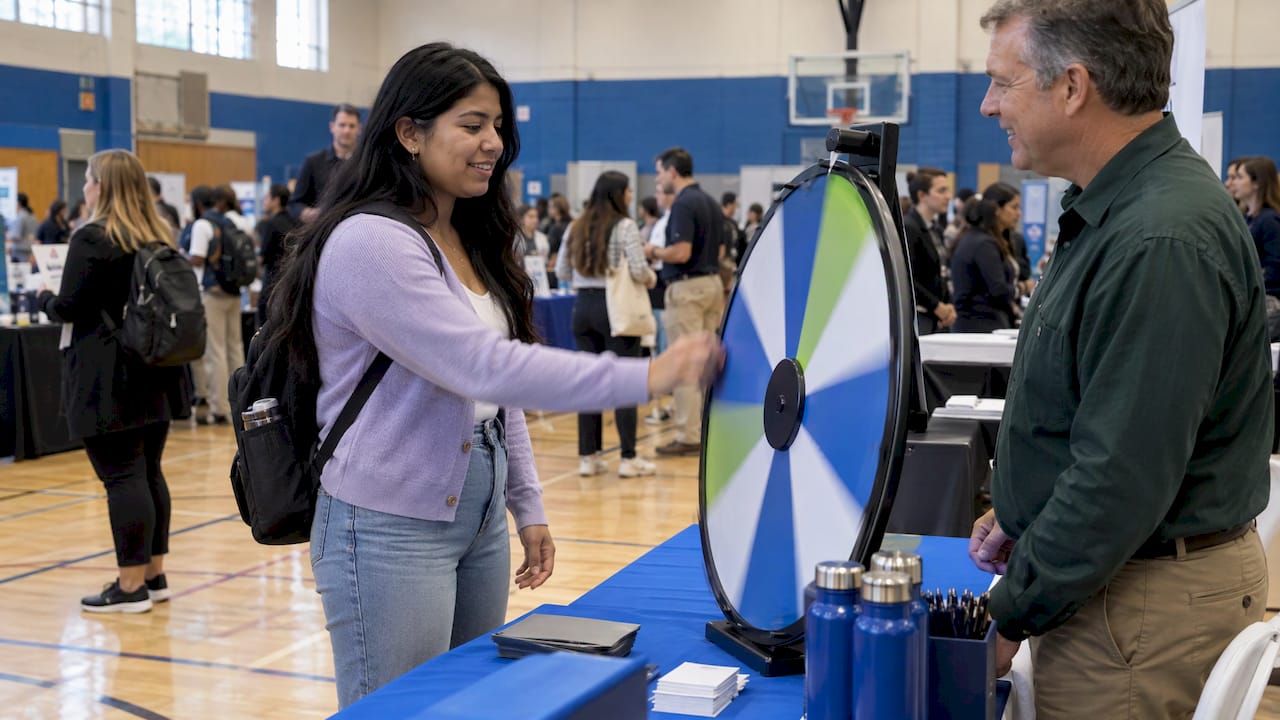
A spinning wheel draws a crowd in a way a bowl of pens never will. Other students see a spin, hear the reaction and wander over. rsvpBOOK offers two formats for booth prizes: an Instant Prize Wheel or a live Winner Drawing.
Which to use:
| Format | Best when | What happens |
|---|---|---|
| Instant Prize Wheel | You expect steady traffic and want a lively booth | Student answers questions, spins, learns the result right away |
| Winner Drawing | Your booth is small or you want to keep conversations going | Student answers questions and receives an entry; a winner is drawn at the end of the day |
You can also combine them: wheel spins for small prizes, a drawing for a larger one.
Add a dedicated greeter
A recruiter in a deep conversation cannot also welcome the next student. Assign one person to greet walk-bys, point them to the QR code or the wheel, and hand them to a recruiter when one is free. MIT’s advice to staff more than one representative, so that lines do not deter students, supports this.
IU South Bend adds practical habits: stand in front of the table so there is no barrier between you and students, wear name tags, and always keep at least one person at the table.
Promote the booth before the fair
Traffic starts before the doors open. MIT suggests using Handshake to send personal invitations to well-matched students. The University of Montana recommends promoting through Handshake and the career center’s Instagram. Mention your prize and the roles you are hiring for, so students plan to visit you.
For a wider view on pre-fair outreach, staffing and conversation training, this guide to capturing leads at events covers principles that carry over to campus recruiting.
Capturing candidate info without a paper stack
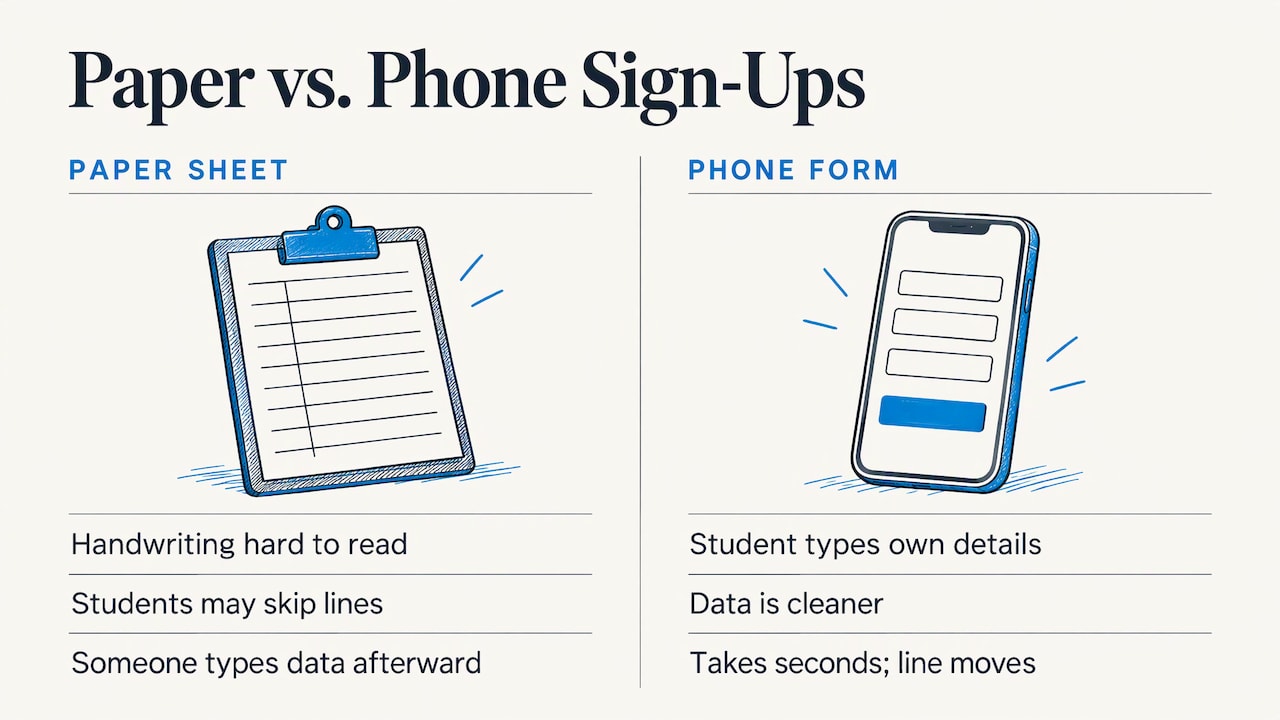
A clipboard sign-up sheet has familiar problems. Handwriting is hard to read, students skip lines, and someone has to type everything in afterward. MIT’s advice points the other way: collect resumes or check-ins via LinkedIn or online methods rather than paper.
A phone-based form fixes most of this. The student types their own details, so the data is cleaner. It also takes seconds, so the line moves.
Ask the questions that sort candidates later
Keep it short. Three to six questions is plenty at a busy fair. Good ones for campus recruiting:
- Major or field of study
- Graduation year
- Role or team of interest (internship, full-time, co-op)
- Work authorization, if it matters for your open roles
- Preferred location
- How they heard about you
Major and graduation year do the most work. They let you split your list by hiring need the next morning: seniors for full-time roles in one group, juniors for internships in another.
Plan the follow-up before you pack
Decide who emails whom, and when. A simple plan:
- Within 48 hours: a thank-you note to every captured candidate, with a link to your careers page.
- Within a week: personal outreach to the candidates who match open roles.
- Later in the term: a reminder about application deadlines for your internship or graduate program.
This only works if your candidate list is already organized by major, year and interest, which is why the questions matter.
How the Career Fair Giveaway works
rsvpBOOK’s Career Fair Giveaway turns the prize idea into a candidate capture system. Here is the flow:
- A student scans a QR code at your booth with their own phone.
- They answer your custom recruiting questions, such as major and graduation year.
- They spin an Instant Prize Wheel, or get an entry for an end-of-day Winner Drawing.
- You receive an exportable candidate list.
There is nothing for the student to download or sign into at the booth, and your team does not enter anything by hand. The QR code can sit on a banner, a table card or a lanyard, so students can scan while they wait for a recruiter.
The wheel adds booth traffic. The questions add the data. The list gives your recruiters something to work from when they are back at their desks.
Recruiting teams can see the Career Fair Giveaway and QR lead capture page for the setup. The tool is priced per event, starting at $99.
Set it up so the booth stays smooth
A few habits make a big difference on the day:
- Put the QR code at eye level, with a short instruction: “Scan, answer 4 questions, spin to win.”
- Keep the prize list simple and visible. Students should know what they might win before they scan.
- Use prizes your target students actually want, such as water bottles, tote bags or branded tech accessories.
- Give your greeter a script: “Scan the code and spin the wheel, then a recruiter will chat with you.”
- Save the best prize for the end-of-day drawing, and announce it at your booth. Students who entered often come back.
Trim the budget without losing impact
The largest cost is usually the booth fee. Iowa State’s listed fee is $950 per 8’ x 8’ booth, and that figure is the school’s, not a universal price. Check your own fair’s rate. Then spend the rest where it changes behavior:
- Worth the money: a clear banner, a clean tablecloth, a prize students want, and a way to capture data.
- Easy to trim: heavy printing. IU South Bend recommends providing literature with a website link to reduce printing costs. Put a QR code to your careers page on a small card instead of handing out thick packets.
- Sustainable swag: the University of Montana encourages sustainable swag, which students tend to keep and use.
A booth checklist for the day before
- Confirm table size, power access and booth rules with the fair organizer.
- Charge tablets, phones and any displays.
- Print the QR code in two sizes and test it from a few feet away.
- Brief every staff member on the three booth jobs: get noticed, get talking, get data.
- Assign roles: greeter, recruiter, and someone to manage the wheel or drawing.
- Pack backup supplies: tape, scissors, extension cord and spare pens.
- Set your follow-up dates and templates.
Why we build for the follow-up
We have supported event organizers since 2004, and one pattern holds across trade shows and campus fairs. Booth activity is easy to create. Booth activity that turns into a usable list is harder.
That is why the Career Fair Giveaway starts with the questions a recruiter will actually use. The wheel brings students over. The form, which students complete on their own phones, gives the recruiter something to sort the next morning.
We also built it to stand alone. A recruiting team does not need to run a full event platform to use it. For fair hosts and organizers who want the whole event in one record, from registration to exhibitor programs, the rest of rsvpBOOK connects to the same approach.
Our advice to recruiting teams: decide what you need to know about a student before the fair, ask only that, and make the first step so quick that no student skips it.
Droshawn
Running the whole fair? Here is what rsvpBOOK does
If you host the career fair rather than staff a booth, rsvpBOOK is event management and registration software that connects registration, payments, onsite operations, exhibitor programs and reporting in one record. Organizers can use lead retrieval for exhibitors, QR check-in that works on any smartphone, and interactive booth maps.
Pricing is per registration, with discounted rates for nonprofits and government. Hands-on implementation support is available when an event needs it. Badge printing and check-in kiosk hardware are optional add-on rentals. It is a flexible alternative to enterprise event platforms for teams that want adaptable setup without the weight.
Standalone booth giveaway tools start at $99 per event. You can see the options on the pricing page.
FAQ
What should employers bring to a career fair booth?
Bring a tablecloth, signage with your company name and logo, brochures, business cards and a list of current openings. Add swag, a banner and a way to capture student details digitally. Check the fair’s employer page first, since tables, power and tablecloths differ by school.
How do I get more students to stop at my booth?
Combine a readable banner, something students can try or win, and a greeter who welcomes walk-bys. A prize wheel adds visible activity that draws a crowd. Promoting your booth and prize through the school’s career platform before the fair helps too.
What information should I collect from students?
Ask for name, email, major, graduation year and the type of role they want. Add one or two questions tied to your open positions. Keep the form short so students finish it in under a minute.
Are prize giveaways worth it at a career fair?
They are when entering also captures useful information. A giveaway that asks about major and graduation year gives you a sortable list, not just a crowd. rsvpBOOK’s Career Fair Giveaway is designed that way and starts at $99 per event.
Can I use a giveaway for trade shows too?
Yes. The same booth giveaway tools, with an Instant Prize Wheel or live Winner Drawing, are used by exhibitors at trade shows. The questions change from recruiting to sales.
Ready to try it at your next fair?
Book a demo to see the Career Fair Giveaway in action, or start building an event free.
Sources
- University of Alaska Fairbanks, Fall Career Fair guide for employers
- MIT Career Advising & Professional Development, career fair advice for employers
- Michigan Technological University, employer information for career fairs
- Iowa State Engineering Career Services, career fair information for employers
- Northern Arizona University, College & Career Fair Toolkit
- Indiana University South Bend, job fair tips for employers
- University of Montana Career Center, attend a career fair
Recommended
- Career Fair Giveaway & QR Lead Capture for Recruiters
- Interactive Exhibitor Information Kiosks
- How to Choose Trade Show Booth Giveaways That Generate Leads
- Lead Capture Apps for Trade Shows: How to Choose in 2026
Planning an event that doesn’t fit neatly into somebody else’s template? See how rsvpBOOK handles registration, onsite check-in, lead retrieval and engagement in one platform. Book a demo: https://www.rsvpbook.com/book-a-demo