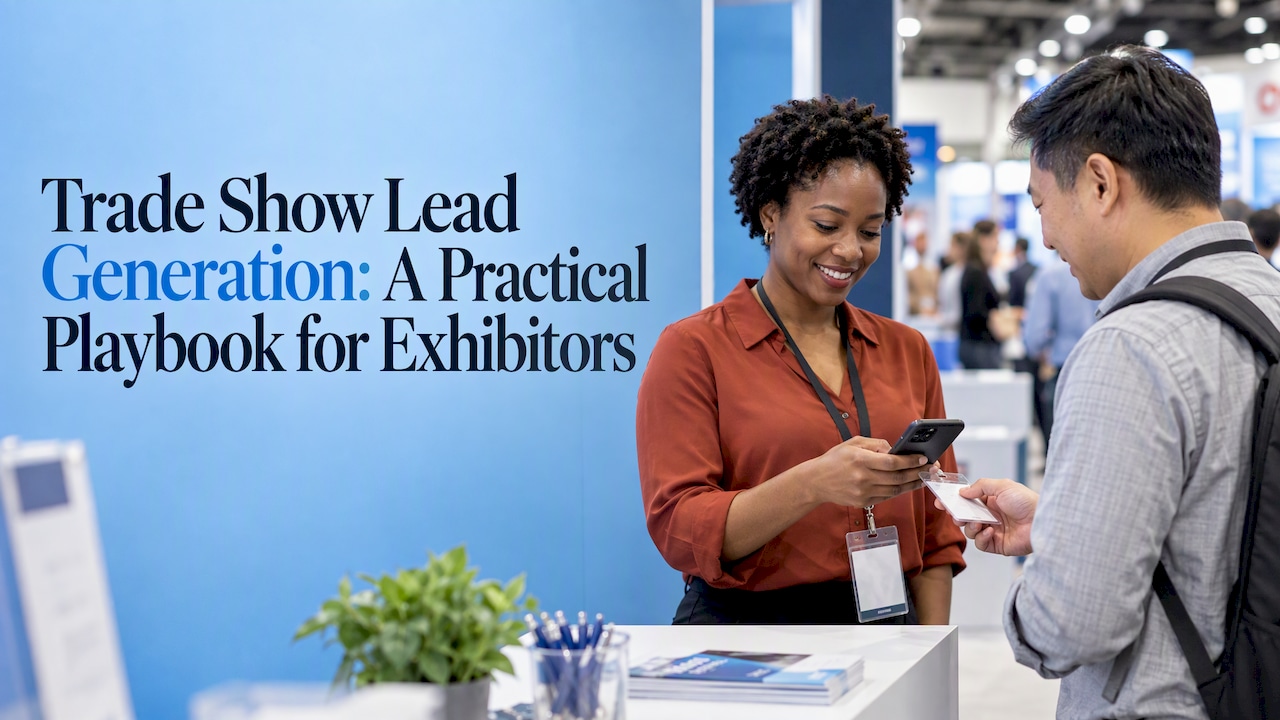
Trade show lead generation works when an exhibitor treats the show as a process with three stages: preparation before the doors open, qualified conversations on the floor, and fast, personal follow-up afterward. Booth traffic alone does not produce pipeline. Clear goals, a trained team, a reliable way to capture each visitor’s details and a measurement plan do. This guide walks through each stage in the order exhibitors face it, and shows where lead retrieval, QR scanning and booth giveaways fit.
TL;DR
- Set specific goals before the show, such as a number of qualified leads by closing time, and define the ideal visitor by role, company type, geography and size.
- Train booth staff in at least two sessions and give them a short opening line instead of “Can I help you?”.
- Capture every visitor in a consistent way, with qualifying notes on decision-making role, timeline and business problem.
- Contact hot leads within one to two business days with a personal message that references the conversation.
- Measure cost per qualified lead and return on investment using gross profit, and keep tracking deals as they close.
Table of Contents
- Start With Goals the Team Can Measure
- Define the Ideal Visitor Before Anyone Walks In
- Prepare the Booth Team
- Start Conversations That Qualify
- Lead Capture and Lead Retrieval: What Teams Collect
- Use Booth Giveaways to Earn Qualified Contact Details
- Follow Up Fast and Make It Personal
- Measure Results and Return on Investment
- What Organizers Can Do to Improve Exhibitor Results
- Our Perspective
- Put Lead Generation Tools to Work at Your Next Show
- FAQ
- Sources
Start With Goals the Team Can Measure
A show without a target cannot be judged afterward. Professional exhibitor guidance recommends S.M.A.R.T. goals, for example capturing at least 25 qualified leads by closing time, meeting the top 10 customers during the show, or opening five new accounts within six months.
These examples show the range of useful goals. One goal is about volume of qualified conversations. Another is about relationships with existing customers. A third is about revenue on a longer clock. A single show can carry all three, as long as each has a number and a deadline.
A practical goal sheet for a booth team includes:
- Lead target: the number of qualified leads, not total badge scans.
- Meeting target: the number of scheduled appointments with priority accounts.
- Revenue target: new accounts or pipeline value expected within a stated window.
- Budget ceiling: the total cost of space, travel, staffing, shipping and giveaways, so cost per lead can be calculated later.
Goals also decide staffing and tools. A team aiming for 25 qualified leads needs a different capture workflow than one hoping to meet a short list of named accounts.
Define the Ideal Visitor Before Anyone Walks In
Qualifying a visitor at the booth is easier when the team already knows who they are looking for. Exhibitor briefings advise defining the ideal visitor by relationship, company type, job function, geography and size, then building internal and external prospect lists.
In practice, that produces two lists:
- Internal list: current customers, open opportunities and past contacts from the sales team’s CRM. These are the people to invite to the booth and to book meetings with.
- External list: target companies and titles drawn from the show’s attendee or exhibitor information, where the organizer shares it, and from the team’s own research.
The ideal-visitor profile then becomes the first filter on the floor. A booth team that agrees on three or four criteria, such as job function, company size and region, can sort visitors in the first minute of a conversation.
Prepare the Booth Team
Booth staff are the lead generation engine. A beautiful booth with an untrained team produces polite chats and thin notes. Preparation covers four areas:
- Goals and messaging: every team member can state the show goal and a short description of what the company solves.
- Qualifying criteria: a shared definition of a hot, warm and cold lead.
- Technology: each person has practiced the capture workflow on the actual devices used at the show.
- Role-play: staff rehearse opening lines, common objections and polite exits from conversations with non-buyers.
Training is often split into two sessions: one for goals, messaging, qualification and tools, and a second for rehearsing conversations. Doing the technology walk-through before the show prevents the most common failure on the floor, which is a team member who cannot scan a badge or save a note while a prospect waits.
Shift planning matters too. Staff should rotate so that the people talking to visitors are fresh, and so that at least one person handles the capture workflow and the giveaway while others hold conversations.
Start Conversations That Qualify
The opening line sets the tone. Export-finance guidance from a Canadian government agency suggests smiling, avoiding “Can I help you?”, delivering a 30-second value proposition when appropriate, and quickly asking about the visitor’s needs and business problems.
A closed question invites “No, just looking.” An open question about the visitor’s work gives them a reason to stay. Examples of useful openers:
- “What brought you to the show this year?”
- “Which part of your event or sales process are you trying to improve?”
- “Are you here to evaluate options or just gathering information?”
The aim of the first minute is to learn what the visitor does and what problem they carry. The 30-second value proposition follows only when it fits what they said.
What to Ask Before the Visitor Leaves
On the floor, staff should quickly qualify visitors on decision-making role, timeline and business problems, so time is not spent on non-buyers. Three short questions cover it:
- Role: “What is your part in choosing a solution like this?”
- Timeline: “When are you hoping to have something in place?”
- Problem: “What is the main issue you want to fix?”
The answers go directly into the lead record, not into memory. A note written at the booth is worth more than a recollection three days later.
Lead Capture and Lead Retrieval: What Teams Collect
The two terms are often used together. Lead capture is the broad act of recording a visitor’s information by any method: a business card, a form, a QR code or a badge scan. Lead retrieval usually means scanning the visitor’s event badge so that registration data flows into the exhibitor’s lead list. Trade publications note that rental systems are often provided by the organizer’s official contractor and work with event registration to supply scanned badge data, and that systems can also include custom qualifying questions and notes.
Whatever the method, a useful lead record includes:
- Name, company, title, email and phone, ideally from the badge scan rather than typed by hand.
- The three qualifying answers: role, timeline and problem.
- A rating such as hot, warm or cold, assigned at the booth.
- A free-text note with what was discussed and the agreed next step.
- The name of the staff member who spoke with the visitor.
Scanning removes transcription errors and speeds up the line at busy moments. The notes and rating are what turn a contact into a lead someone in sales can act on.
Organizers who want to give exhibitors this experience can offer lead retrieval for event organizers with packages and control over how scanning is delivered. Exhibitors who need their own scanning workflow can look at rsvpBOOK’s lead retrieval software for trade shows, which connects scans to the registration record.
Use Booth Giveaways to Earn Qualified Contact Details
A prize draw is a reason for a visitor to stop. It becomes lead generation only when entry requires the details the team needs and the moment is tied to a conversation. A few principles keep giveaways productive:
- Entry equals capture. Visitors enter by scanning their badge or a QR code, so every entry is a lead record rather than a stack of paper slips.
- Prize relevance. A prize that appeals to the ideal visitor attracts the right crowd. A generic prize attracts everyone.
- Live moments. An instant prize wheel or a scheduled winner drawing brings people to the booth at known times, which gives staff a window for conversations.
- Qualification still happens. The giveaway starts the interaction. The three qualifying questions finish it.
rsvpBOOK offers an Instant Prize Wheel and live Winner Drawing built for this purpose, and the same approach is used by recruiting teams at career fairs through its career fair giveaway and QR lead capture. Booth giveaway tools are listed from $99 one-off per event on the pricing page.
For organizers, interactive booth maps, scavenger hunts and gamification add reasons for attendees to visit specific booths, which raises the number of visitors each exhibitor can talk to.
Follow Up Fast and Make It Personal
Most of the value of a trade show is decided in the week after it. Guidance for exhibitors is consistent: hot leads should receive a personal call or meeting request within one to two business days, referencing the conversation, with further contact planned according to the buyer’s potential. Show organizers who coach exhibitors on lead quality state it simply: fast information delivery equals higher conversion.

Prioritize by Urgency, Authority and Fit
Not every lead gets the same treatment. Effective follow-up ranks leads by urgency, decision authority and fit, including how soon the buyer needs to act. A simple routing table helps:
| Lead rating | Typical signal | Next step |
|---|---|---|
| Hot | Decision-maker, near-term timeline, clear problem | Personal call or meeting request within one to two business days |
| Warm | Influencer or longer timeline, relevant problem | Personalized email with relevant resources, then a scheduled touchpoint |
| Cold | Poor fit or no near-term need | Add to a nurture list, no sales time |
Personalize the Message
Post-show messages should reflect each visitor’s interests and needs, not a mass template. This is where booth notes pay off. A message that mentions the problem the visitor described, and offers one clear next step, reads as a continuation of the conversation.
A workable sequence:
- Same day or next morning: export the leads, assign owners and flag the hot ones.
- Within two business days: hot leads get a call or meeting request.
- Within the first week: warm leads receive a personalized email tied to their stated problem.
- Following weeks: remaining contacts enter a nurture track, with further contact planned by buyer potential.
Speed depends on data being usable right away. Leads that sit in a spreadsheet waiting for cleanup lose days. Leads that arrive already structured, with ratings and notes, can be routed in minutes.
Measure Results and Return on Investment
Measurement closes the loop and makes the next show better. Exhibitors should track cost per qualified lead and ROI based on gross profit, review results within a week, and keep tracking deals over a longer window as they close.
A basic scorecard compares the goals set at the start with actual results:
- Qualified leads captured versus the target.
- Total show cost divided by qualified leads, which gives cost per qualified lead.
- Meetings held with priority accounts.
- Pipeline and closed revenue attributed to the show, updated as deals progress.
- Gross profit from closed deals compared with total show cost, which gives ROI.
Using gross profit rather than revenue keeps the comparison honest, since it reflects what the business actually keeps. Because sales cycles for many B2B products run longer than a week, the first review looks at lead quality and speed of follow-up, and later reviews look at closed business.
Custom reporting helps here. rsvpBOOK’s custom reports and automated alerts let organizers see scan activity, check-in and engagement data in one place, without reconciling separate systems.
What Organizers Can Do to Improve Exhibitor Results
Exhibitor satisfaction depends on how many qualified visitors reach the floor and how easily exhibitors can capture them. Organizers shape this in several ways:
- Registration data: custom questions on the registration form give exhibitors useful context, such as job function and interests, when a badge is scanned.
- Badges: well-designed name badges with scannable codes make retrieval fast and reliable.
- QR codes: QR code management supports check-in, booth visits and giveaway entries from a single set of codes.
- Traffic drivers: scavenger hunts, trivia and prize drawings direct attendees to exhibitor booths.
- Onsite flow: QR check-in and Kiosk+ self check-in shorten entry lines so attendees reach the exhibit hall sooner.
When registration, badges, check-in and lead retrieval share one record, exhibitors receive cleaner data and organizers can show sponsors what the show delivered.
Our Perspective
Exhibitors rarely lose leads because of a bad booth. They lose them in the gap between the show floor and the sales team: contact details in one place, notes in another, and follow-up that starts a week late.
We built rsvpBOOK to connect every stage of an event in one record: registration, payments, sessions, onsite operations, exhibitor programs, engagement and reporting. When a visitor registers, checks in with a QR code on any smartphone and is scanned at a booth, the data belongs to the same record. Nothing has to be retyped, and nothing waits for cleanup.
Our booth giveaway tools are designed around the same idea. An Instant Prize Wheel or a live Winner Drawing gives visitors a reason to stop, and the scan that enters them becomes a lead record. The booth conversation, with its qualifying questions and notes, finishes the job. Vendor engagement turns into usable data.
Organizers choose how much support they want. Some build their own setup with our AI-assisted builder, which turns an event design document into a working configuration. Others prefer hands-on implementation help. Pricing is per registration, with discounted rates for nonprofits and government organizations, so associations and public-sector events can offer exhibitors the same tools as larger shows.
Droshawn
Put Lead Generation Tools to Work at Your Next Show
rsvpBOOK gives organizers and exhibitors a connected way to run the lead side of a trade show: badge and QR scanning, qualifying notes, interactive booth maps, giveaways and reporting, all tied to the event registration record. Organizers can start with event management software for the whole show, or add lead retrieval and booth giveaway modules where they are needed.
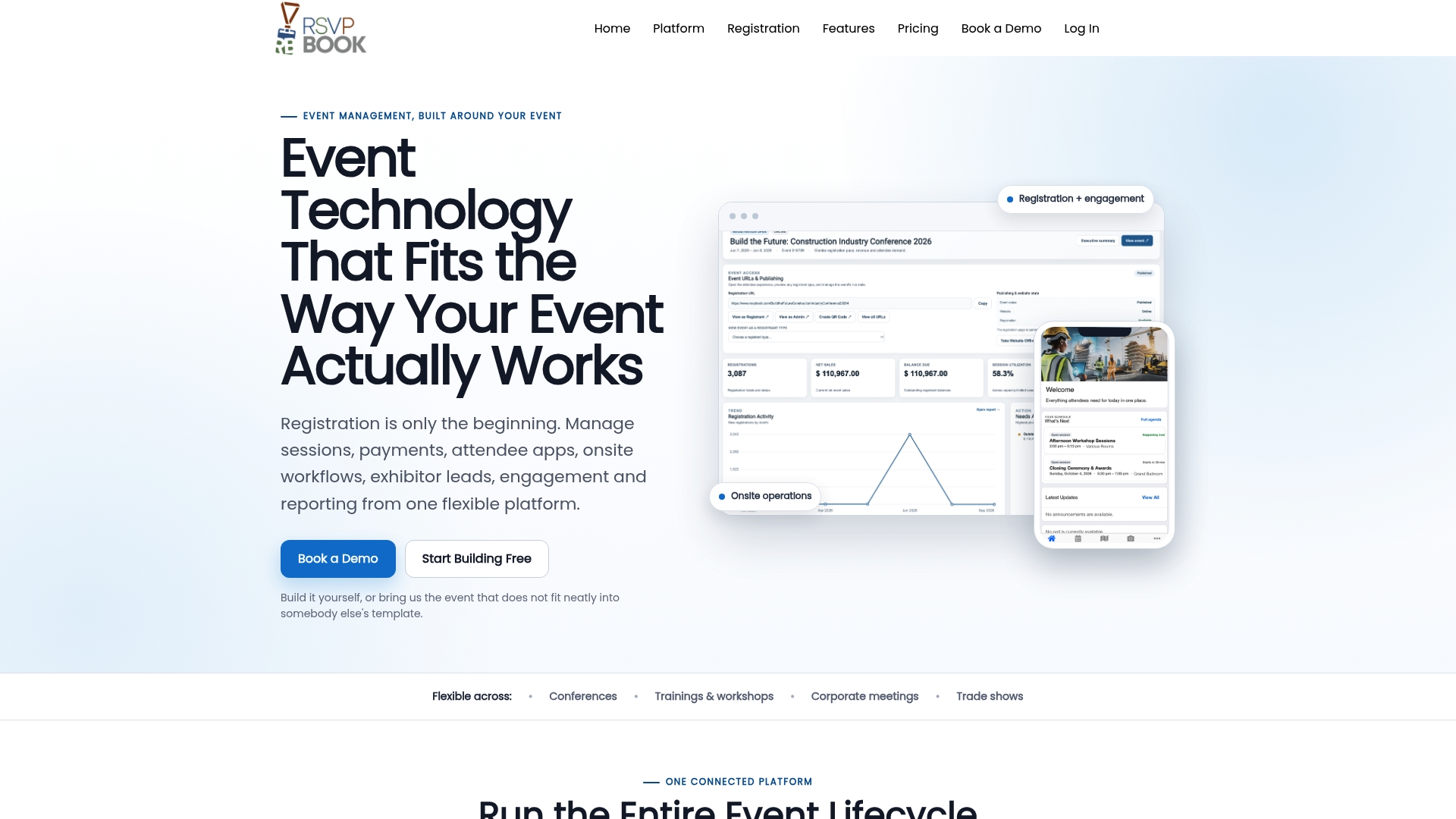
Booth giveaway tools start at $99 one-off per event, and the pricing page lists the other modules. Teams that want help configuring a show can request hands-on implementation support.
FAQ
What is the best way to generate leads at a trade show?
The most reliable approach combines preparation and process. Set measurable goals, define the ideal visitor, train booth staff, capture every visitor with a consistent method and qualify on role, timeline and problem. Then follow up with hot leads within one to two business days.
How many leads should an exhibitor aim to capture?
The right number depends on the show, the booth and the sales cycle. Exhibitor guidance gives an example of at least 25 qualified leads by closing time as a S.M.A.R.T. goal. Teams should set their own target from past results and budget, and count qualified leads rather than total scans.
What is the difference between lead capture and lead retrieval?
Lead capture covers any method of recording a visitor’s details, from business cards to forms and QR codes. Lead retrieval typically refers to scanning the event badge so registration data feeds the exhibitor’s lead list, often with custom qualifying questions and notes, as described by trade show industry reporting.
How soon should a team follow up after a trade show?
Hot leads should hear back within one to two business days with a personal call or meeting request that references the conversation. Warm leads can receive a personalized email in the first week, as described in exhibitor ROI guidance.
How do exhibitors measure trade show ROI?
Exhibitors calculate cost per qualified lead and ROI using gross profit, review the first results within a week and keep tracking deals as they close. Comparing results with the goals set before the show shows what to repeat and what to change.
Sources
- NAA: Define Your Outcomes (exhibitor goals and S.M.A.R.T. targets)
- New Exhibitor Web-Briefing (ideal visitor and prospect lists)
- How to get the most from your trade show investment (booth conversations)
- Golden Retrieval (lead retrieval systems)
- Maximize ROI at Diesel Industry Trade Shows (qualifying, follow-up and ROI)
- Lead Quality & Conversion workbook (personalized, fast follow-up)