The event marketing strategies that work follow one chain: a clear goal, one registration page that every channel points to, a mix of five to seven channels, onsite engagement that produces data, and follow-up built from that data. When registration, check-in, booth activity and reporting live in one record, each step feeds the next. rsvpBOOK has supported event organizers since 2004 and was built to connect those steps.
This guide walks through the plan in order, with the numbers and sources behind each step.
TL;DR
- Start with one or two measurable goals (registrations, leads, press, retention). Every channel and metric follows from them.
- Send every channel to a single branded registration page with a clear call to action, and tag each link so you can see which channel produced each registration.
- Plan for five to seven channels, with email first. Segment past attendees from new contacts and give speakers, sponsors and partners ready-made posts.
- Marketing continues at the event. Check-in data, lead capture, prize giveaways and gamification turn attendance into follow-up you can act on.
- Measure registrations by channel, cost per registration, attendance against registrations, leads and survey feedback.
Table of Contents
- What event marketing is, and what it can do for you
- Build the plan: goals, audience, budget, timeline
- Make the registration page the center of everything
- Channels that drive registrations
- A quick channel guide
- Keep marketing at the event: engagement that creates data
- Follow up and measure
- What about the 5 Ps of event marketing?
- Our perspective
- Put it to work with rsvpBOOK
- FAQ
- Sources
What event marketing is, and what it can do for you
Event marketing uses in-person, virtual or hybrid events to promote a product, service, brand or cause. Mailchimp lists lead generation, brand promotion, customer engagement, launches and thought leadership as the typical goals.
Goals shift with the audience. The EventTrack 2026 study by Event Marketer surveyed more than 1,000 U.S. corporate marketers in summer 2025. It found that 64% of B2C marketers named press hits as their top event goal. Another 58% named engaging audiences and building relationships, and 55% named awareness.
On the B2B side, a survey of 327 business professionals published in October 2025 found that 84% of companies take part in trade shows. Lead generation (67%), brand awareness (62%) and networking (62%) led the goals.
Pick one or two goals before you pick a channel. A trade show organizer filling a floor needs a different plan than a nonprofit selling gala tables or a recruiter working a career fair.
Build the plan: goals, audience, budget, timeline
A workable plan has four parts.
- Goals. Use the SMART framework (Specific, Measurable, Achievable, Relevant, Time-bound), which Constant Contact recommends for event goals. “600 paid registrations and 40 sponsor leads” is a goal. “Great buzz” is not.
- Audience. Write down who you want in the room and why they would come. Past attendees, members, prospects and partners’ contacts usually need different messages.
- Budget. Define registration, lead or awareness goals first, then set the budget and divide it across channels, as Asana’s planning guidance advises.
- Timeline. HubSpot suggests at least a month of promotion for small events and ideally three months for large, high-investment ones.
Most teams also settle the event’s basic offer here: format, theme, ticket types, pricing and early-bird deadlines. Those choices become the content of your registration page.
Make the registration page the center of everything
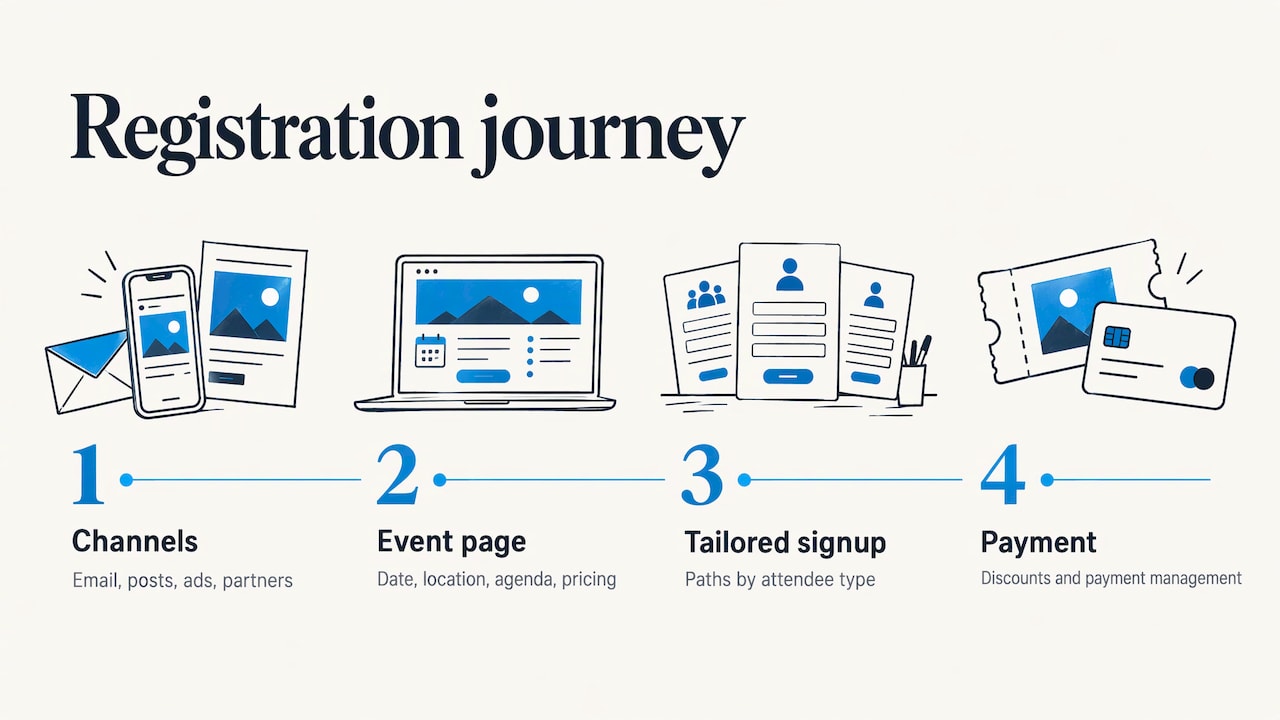
Every email, post, ad and partner mention should land in one place. Great Event recommends using a current event website or registration page as the destination for every channel.
That page needs the date, location, agenda, speakers, pricing and one obvious action. It should also match your audience. A conference with multiple attendee types needs a registration path for each, and a gala needs table and group options.
With rsvpBOOK, organizers build branded registration websites with custom questions, registrant types, group and table registration, discounts, sessions, workshops, appointments and hotel room blocks. The registration form can ask how each person heard about the event, which gives you channel data without extra work later.
Promotion tools sit on the same page. Discount codes support early-bird pricing, and event ticketing and payment management keep the path from interest to paid registration short.
For a deeper look at the promotion side, see our practical event promotion plan.
Channels that drive registrations
No single channel fills an event. AMW’s planning guide says most events need a mix of five to seven channels, and that email is typically the highest-converting one. It also says the final two weeks before an event typically produce 25 to 40 percent of total registrations. Plan your reminders and last-chance messages for that stretch.
Use email for announcements, deadline reminders and invitations. Great Event advises segmenting past attendees from new contacts. Past attendees can get a “welcome back” message. New contacts need more explanation of why the event is worth their time.
A simple sequence works for most events:
- Announcement, with the registration link.
- Speaker or agenda highlight.
- Early-bird deadline reminder.
- Social proof, such as who is already registered, where you have permission to share it.
- Final-week reminder and last-chance message.
Social media
Match the platform to the audience. The Event Planner Expo’s playbook suggests LinkedIn for B2B and professional events, Instagram for visual experiences, TikTok for younger audiences, Facebook for community and local events, and X for live public conversation.
The same guide proposes a 90-to-60-day awareness phase with the announcement, speaker spotlights, industry data and a consistent hashtag. It suggests three to four posts a week on your main platform and two on secondary ones.
If your event is virtual or hybrid, your content needs to be found beyond your own followers. Search-driven content planning helps, and AI strategies for digital branding shows how brands approach visibility across search and AI engines.
Speakers, sponsors, exhibitors and partners
People trust the people they already follow. According to a TSNN survey of show organizers cited by MyBazooka, 59% of organizers use speakers, attendees and exhibitors sharing their attendance on social media to drive registration. Another 53% use partner marketing.
Make sharing effortless. Give each partner a short kit: two or three ready-made posts, an image and a tracked link. Tracked links also show you which partner delivered.
Paid ads and media
Paid search and paid social work best with a spending cap and channel-level tracking, per Great Event. For press, Constant Contact suggests a press release and invitations to local media. That matters more now that press coverage is a leading goal for consumer event marketers.
Incentives
Early-bird pricing and referral incentives give people a reason to act now rather than later. Both are easy to set up with discount codes on the registration page. Group registration also pushes one decision-maker to bring a whole team.
A quick channel guide
| Channel | Best for | What to track |
|---|---|---|
| Past attendees, members, warm prospects | Registrations by campaign link | |
| B2B conferences, trade shows, recruiting | Clicks and registrations by tagged link | |
| Local, community and nonprofit events | Registrations by source question | |
| Partner and speaker posts | Extending reach through trusted voices | Registrations by partner link or code |
| Paid search and social | Late-stage push, new audiences | Cost per registration |
| Press and local media | Awareness and credibility | Referral traffic and mentions |
Keep marketing at the event: engagement that creates data
What happens onsite is also marketing, and it produces the information your follow-up depends on.
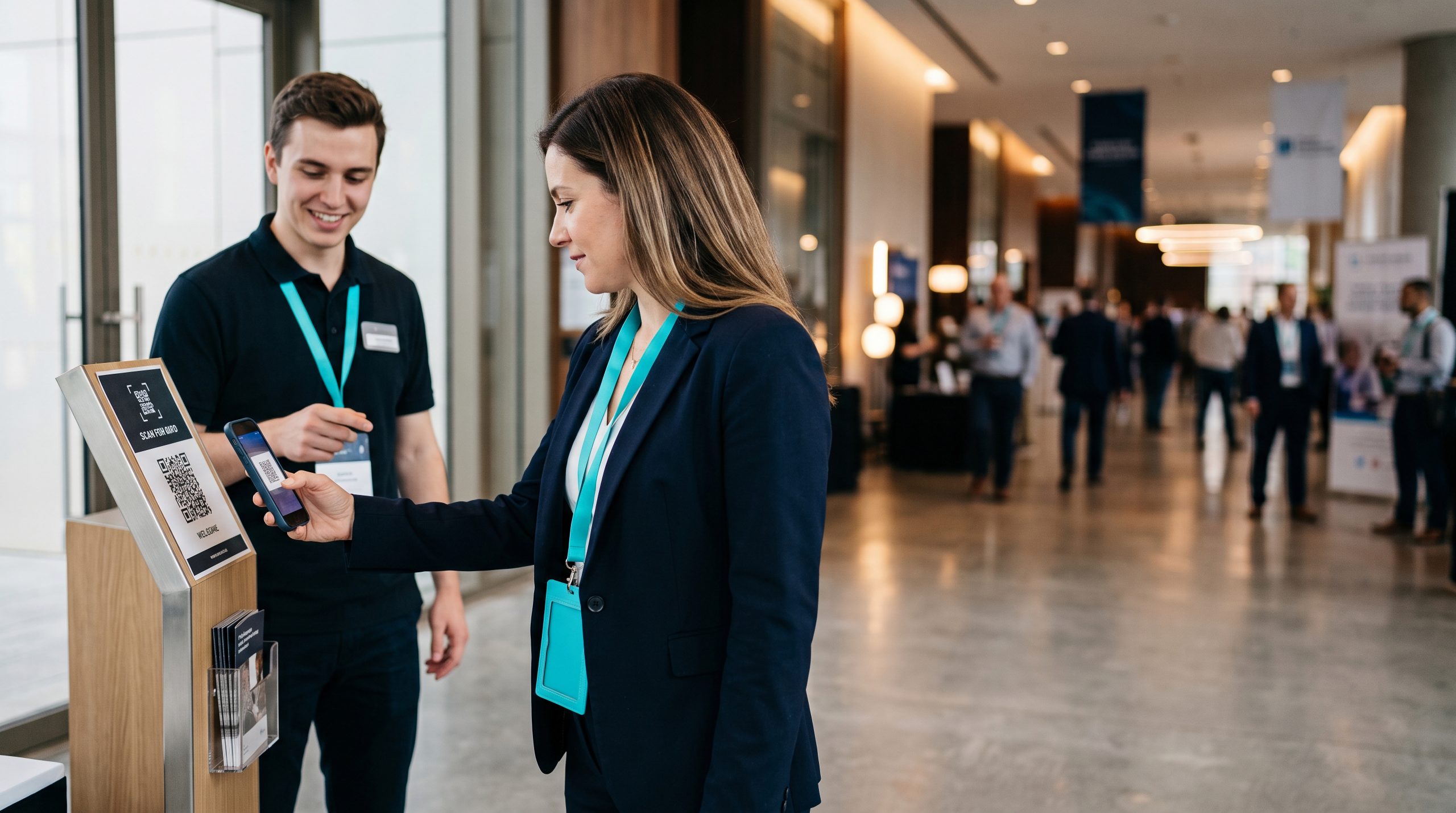
Check-in. QR check-in runs free on any smartphone with rsvpBOOK. For faster lines, Kiosk+ self check-in and custom name badges are available. Badge printing and check-in kiosk hardware are optional add-on rentals. One rsvpBOOK customer moved more than 2,600 attendees through check-in with QR scanning. You can read more about attendance tracking.
Mobile app. The attendee mobile app offers personalized agendas and messaging, so attendees plan their day and you can reach them in real time.
Gamification. Scavenger hunts, trivia and leaderboards give people a reason to visit sponsors, attend sessions and meet each other. See how gamification works for conferences. Networking matters here too: in a Fuse Events survey, networking topped the formats that build community, and planners ranked community as the top driver of loyalty.
SMS reminders. Short texts about session changes, doors opening or a prize drawing keep people moving through the day.
Trade shows: lead retrieval and booth giveaways
Exhibitors judge a show by the leads they take home. rsvpBOOK offers exhibitor and organizer lead retrieval, so booth conversations become qualified records instead of a stack of business cards.
Booth giveaways draw traffic to those conversations. An Instant Prize Wheel or a live Winner Drawing turns a booth visit into a captured lead. Trade show giveaway tools start at $99 per event as a standalone option. Interactive booth maps, with booth sales, help organizers sell floor space and help attendees find exhibitors.
Career fairs: candidates and booth traffic
Recruiters want two things: a steady stream of candidates at the booth and a clean record of each one. The same prize wheel and winner drawing tools used by exhibitors give recruiting teams a reason for candidates to stop. Each visit is captured as a candidate record you can follow up on.
Follow up and measure
The event ends, but the marketing does not. A Forrester survey, cited by Crawford Group, found that 92% of event marketers planned to strengthen post-event follow-up. Another 77% focused on year-round engagement.
Follow-up works best when it is specific to what the person did. Thank attendees who checked in and send session materials to those who attended a workshop. Pass exhibitor leads along quickly, and invite everyone to the next event with an early-bird code.
Metrics worth tracking
Great Event’s measurement list is a solid baseline:
- Registrations by channel
- Cost per registration
- Attendance against registrations
- Leads, sales or donations matched to client records
- Attendee feedback from a post-event survey
Use tagged links, promo codes and a registration-source question to attribute results. VistaPrint’s U.S. guide adds ticket sales, sign-ups, website visits and coupon redemptions as possible KPIs, and recommends reviewing multi-channel attribution afterward.
For experiential events, the Event Marketing Measurement Association lists lead captures, trial or demo interactions, asset engagement and purchase intent among the measures. It also recommends mapping the attendee journey before, during and after the event.
rsvpBOOK supports this with registrant surveys and custom reports, plus automated alerts. Because registration, payments, check-in and lead data share one record, reporting does not require stitching spreadsheets together.
What about the 5 Ps of event marketing?
The 5 Ps are a planning checklist. One version, used in the Event Planner Expo’s workflow, reads: Product (the event), Price (ticketing), Place (venue or virtual platform), Promotion (marketing tactics) and People (audience and team).
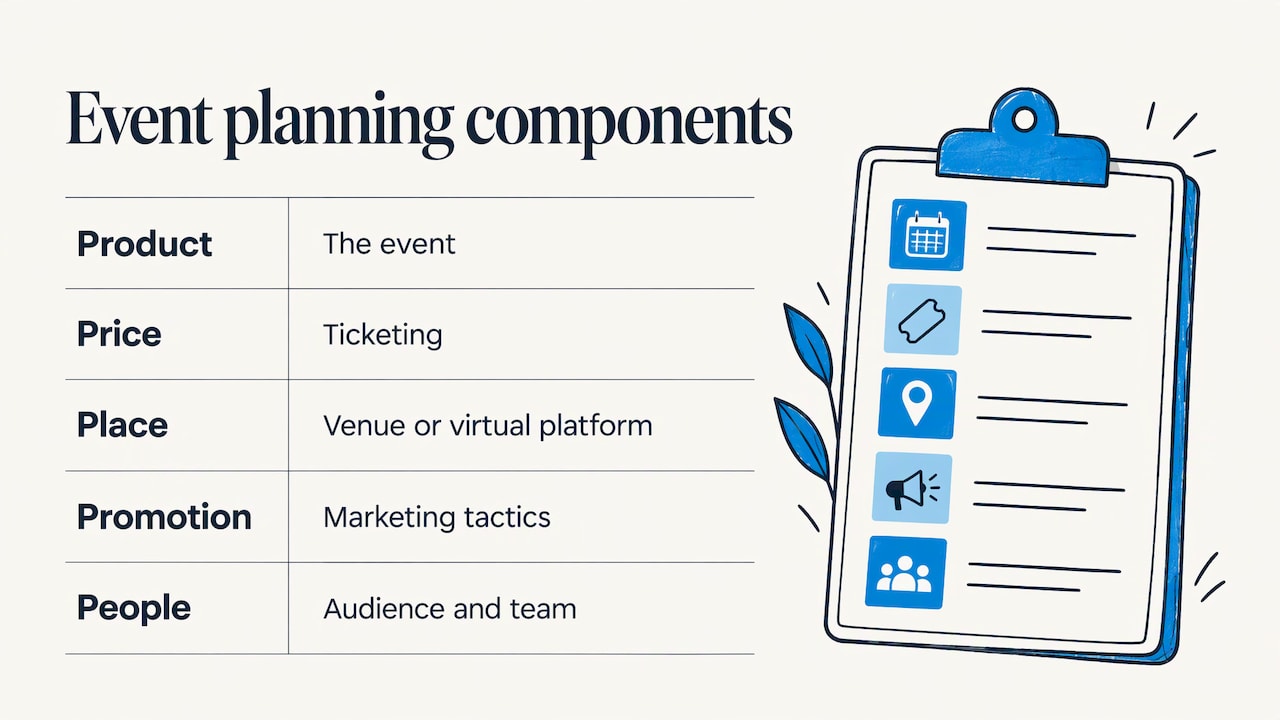
Definitions vary. The classic version has four Ps, and the extended services version has seven, adding Process and Physical Evidence, according to the Event Marketing Measurement Association. Use whichever version helps your team cover every decision.
Our perspective
Most event marketing problems we see described by planners come down to disconnected pieces: a registration tool here, a spreadsheet there, a separate system for check-in and another for booth leads.
We built rsvpBOOK to connect every stage of an event in one record, from registration and payments to sessions, onsite operations, exhibitor programs, engagement and reporting. When the record is shared, a registration source becomes a check-in, a check-in becomes an engagement score, and a booth visit becomes a lead.
That is also why we offer flexible configuration for complex events without the complexity of enterprise platforms. Organizers who want an alternative to large enterprise event platforms can set up on their own or work with our hands-on implementation support.
Pricing is per registration, with discounted rates for nonprofits and government. Better marketing starts with a registration process you control.
Droshawn
Put it to work with rsvpBOOK
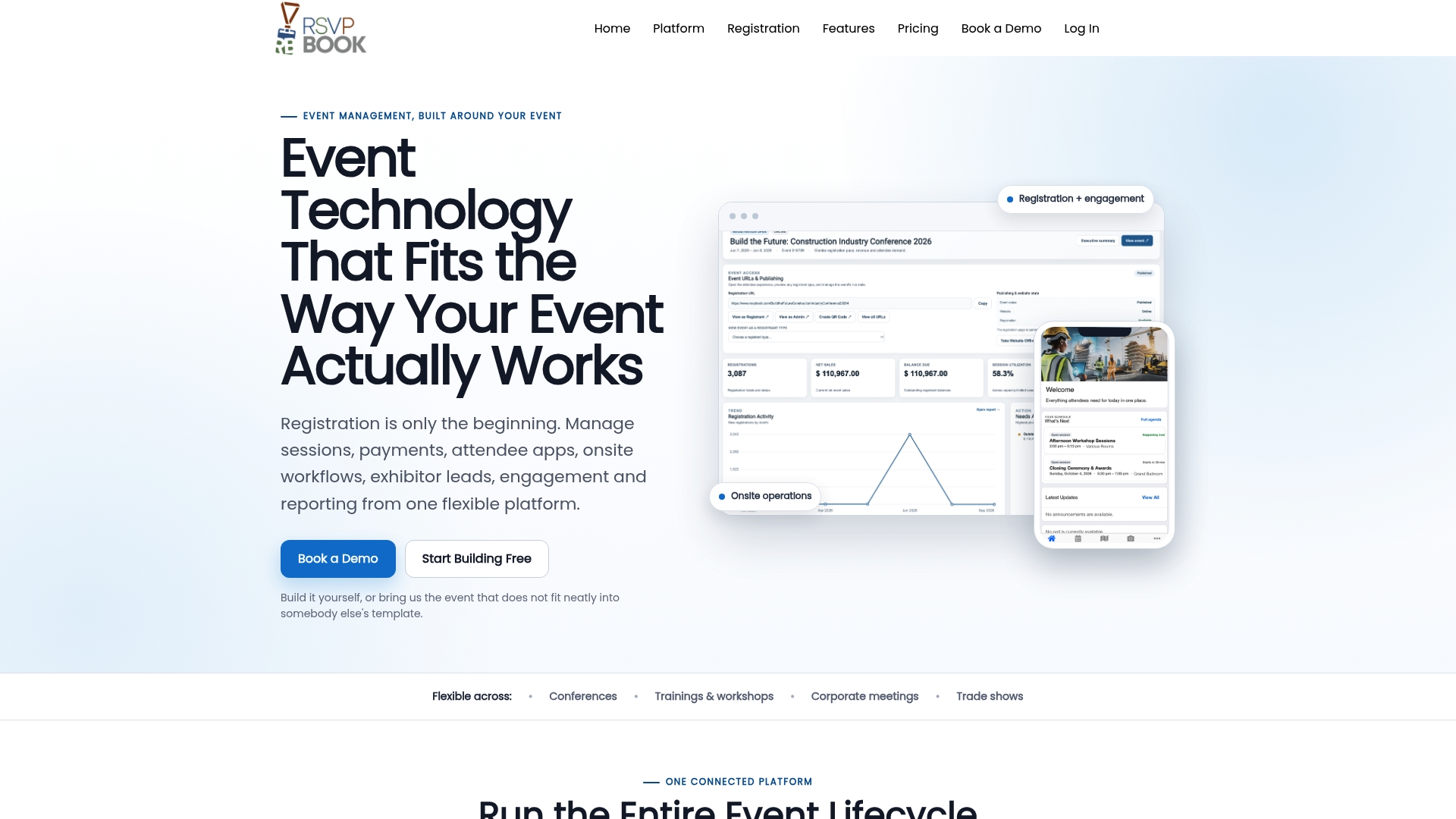
rsvpBOOK gives you the registration site, the onsite tools and the reporting in one place. Pricing is per registration, and nonprofits and government organizations receive discounted rates. Hands-on implementation support is available when your event needs it, and an AI-assisted builder turns an event design document into a working setup.
If you run trade shows, start with lead retrieval and booth giveaways. If you are building the whole event, see event management software or the full feature list.
FAQ
How do you market an event?
Set measurable goals, build one registration page, and promote it through five to seven channels with email first. Give partners and speakers ready-made content with tracked links. Then keep engaging people at the event and follow up afterward, using the data you collected.
How far ahead should you start promoting an event?
HubSpot suggests at least a month for small events and ideally three months for large, high-investment ones. Plan your final-two-weeks push in advance, because that stretch typically brings a large share of registrations.
Which event promotion channel works best?
Email is typically the highest-converting channel for registrations, according to AMW. Social media works best when the platform matches your audience: LinkedIn for professional events, Facebook for local and community events. Use tagged links to see what works for your event.
What metrics show that event marketing worked?
Track registrations by channel, cost per registration, attendance against registrations, leads and post-event survey feedback. Tie each metric back to the goal you set at the start.
Sources
- Event Marketing: From Concept to Execution | Mailchimp
- EventTrack 2026 forecast and benchmark study | Event Marketer
- Survey: Business Professionals Are Committed to Participating in Trade Shows in 2026
- The Ultimate Event Marketing Strategies Guide | Constant Contact
- Event Marketing: How to Build Your Strategy | HubSpot
- Free Event Marketing Plan Template | Asana
- Event Marketing: Plan, Strategy, Ideas and Examples | Great Event
- How to Create an Event Marketing Plan | AMW
- Social Media Event Marketing Playbook | The Event Planner Expo
- Event Marketing Workflow Guide | The Event Planner Expo
- How to Increase Event Registrations | MyBazooka
- Event Personalization at Scale | Crawford Group
- Marketing Principles for Event Marketers | Event Marketing Measurement Association
- Event Promotion Strategy Guide | VistaPrint US
- Branding Through Digital Marketing: AI Strategies for 2026
Ready to see it in action? Book a demo or start building an event free.
Recommended
- Trade Show Lead Generation: A Practical Playbook for Exhibitors
- Event Promotion: A Practical Plan to Fill Your Event
- Lead Retrieval Software for Trade Shows & Exhibitors
- Lead Retrieval for Event Organizers: Packages & Control
Planning an event that doesn’t fit neatly into somebody else’s template? See how rsvpBOOK handles registration, onsite check-in, lead retrieval and engagement in one platform. Book a demo: https://www.rsvpbook.com/book-a-demo