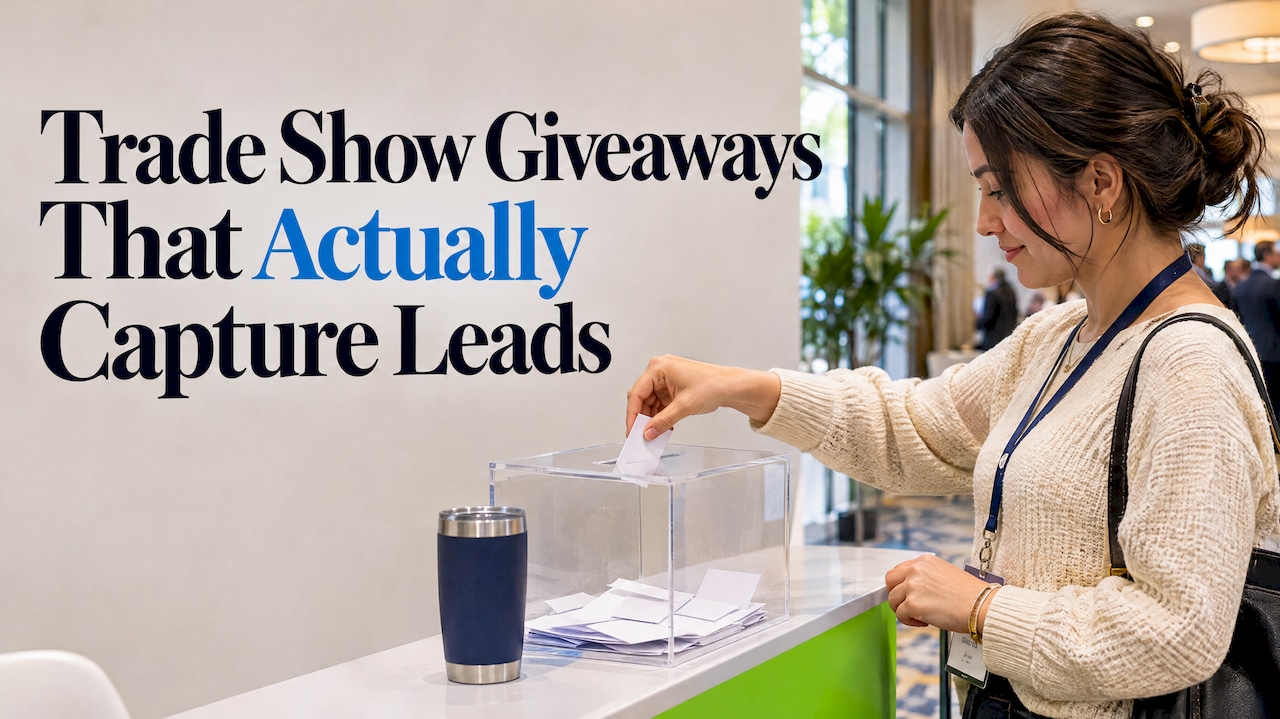
The best trade show booth giveaways are useful items and prizes that visitors earn by sharing their details and answering a qualifying question, not things you hand out to anyone who walks by. A prize wheel spin or an end-of-show drawing, entered by scanning a QR code on the visitor’s own phone, gives you a lead you can follow up on, where a business-card fishbowl gives you a stack of cards with no context. Below are the giveaway ideas worth buying, how to tie them to lead capture, and how to budget and measure the result.
TL;DR
- Useful beats expensive: items that earn a place on a desk or in a bag keep your brand in view long after the show.
- Match the gift to the action: low-cost items for traffic, better prizes for visitors who answer your qualifying questions or book a demo.
- Replace the fishbowl with a QR scan, custom sales questions and a prize wheel or live drawing, so every entry is a qualified lead.
- Size your order from expected booth conversations, not total show attendance.
- Judge success by qualified leads and pipeline, not by how many items left the booth.
Table of Contents
- Giveaway ideas visitors actually keep
- Give more for more: a tiered approach
- Why a business-card fishbowl falls short
- How an rsvpBOOK booth giveaway works
- Set your rules before the show
- How many giveaways to order, and what to spend
- Measuring whether your giveaways worked
- Career fairs: capture candidates and build booth traffic
- Our perspective
- Run your booth giveaway with rsvpBOOK
- FAQ
- Sources
Giveaway ideas visitors actually keep
Start with what people want. The Advertising Specialty Institute’s 2026/2027 impressions study of about 5,000 consumers, as summarized in a guide to trade show swag by price, found that 55% of U.S. respondents would be excited to receive a T-shirt, 52% a fleece or jacket and 51% a food gift. Buttons, lanyards and stickers ranked last at 11%. Food gifts also led on the likelihood of doing business with the giver, at 92%.
That gives you a practical shortlist:
- Totes and bags. Visitors need something to carry the rest of the show’s paper and samples in. A bag with a modest logo gets reused.
- Drinkware. Tumblers and water bottles are daily-use items. PPAI’s Product Power 2026 study, as reported in a roundup of swag statistics, found that 73% of respondents use a branded bottle or tumbler every day.
- Power banks and charging cables. Show floors drain phones. A charger solves a real problem at the moment it appears.
- Quality notebooks and pens. Dave Sarro of Promo Direct told Event Marketer that an item that earns a permanent place on a desk or in a backpack is doing exactly what it was meant to do.
- Snacks and treats. Wrapped mints, chocolate and snack bars are cheap, welcome after hours on the floor and score well in the ASI data.
- A “survival kit.” Event Marketer describes a branded pouch with hand sanitizer, lip balm, mints and electrolyte mix, with a QR code linking to the exhibitor’s website, as a popular alternative to candy or plushies.
Pick for your audience. Tech buyers appreciate chargers and desk accessories. Healthcare crowds like wellness items. Outdoor shows call for sunscreen and sunglasses. If you can picture the item on the recipient’s desk in March, it is probably a good one.
Give more for more: a tiered approach
The item matters less than what the visitor does to get it. A simple tier plan keeps your budget focused:
| Tier | Visitor action | Typical item |
|---|---|---|
| Traffic | Stops at the booth | Candy, stickers, a pen |
| Conversation | Scans a QR code and answers a short question | Tote, notebook, phone stand |
| Qualified lead | Books a demo or requests pricing | Power bank, premium drinkware, a prize spin |
| VIP | Commits to a meeting or case study | Premium tech, apparel, a hosted lunch |
Event Marketer reported that one B2B company built a tiered swag menu where small actions earned small swag and larger rewards required a sales meeting or a case study. The company reported ten times its activation spend in new pipeline. The principle carries to any booth: the more valuable the prize, the more the visitor tells you.
The Wichita Area Builders Association’s exhibitor guide makes the same point in plain terms. Giveaways need a purpose, the exchange (a form, an appointment request or a contest entry) should be made clear to visitors, and confusing rules or low-quality items hurt the brand.
Why a business-card fishbowl falls short
The fishbowl is easy. It is also the weakest way to collect leads.
- No qualification. A card tells you a name. It does not say whether the person is buying this quarter, what problem they have or who else is involved.
- Prize hunters. When the only requirement is dropping in a card, entries come from people who want the prize, not your product.
- Slow follow-up. Someone has to type the cards into a system after the show, and some will be illegible.
- Nothing to measure. You cannot split entries by interest level or see which prize pulled which visitors.
A giveaway tied to lead capture fixes each of these. Your questions sort visitors by need and timeline. Entries land in a list your team can export and work from the same day. For a deeper look at the capture side, see our trade show lead generation playbook and the comparison of badge scanners and digital tools.
How an rsvpBOOK booth giveaway works
rsvpBOOK booth giveaway tools turn a booth visit into a qualified lead in a few steps:
- Visitors scan a QR code on their own phone. Display the code on your counter, banner or table sign. There is no app to download and no device for you to hand out.
- They answer your custom sales qualifying questions. You write the questions: budget, timeline, product interest, whichever signals your sales team uses to prioritize.
- They play for the prize. Depending on how you want to run the booth, visitors spin an Instant Prize Wheel for an immediate result or enter a live end-of-show Winner Drawing that brings people back to your booth at a set time.
- You manage prizes and stock. The tool supports multiple prizes and quantities, so you can mix a few premium prizes with many small ones.
- You take the leads with you. Leads are exportable, with optional webhook delivery if you want them pushed into another system.
Standalone booth giveaway tools start at $99 for a single event, with unlimited scans and leads. You can see the details on the trade show prize wheel and winner drawing page.
The wheel and the drawing suit different booths. The wheel gives instant gratification and draws foot traffic when the aisle is busy. The drawing suits shows where you want a crowd at your booth at a specific time, for example near the end of the final day. Many exhibitors pair a small guaranteed item for every visitor who completes the questions with a larger prize in the drawing.
If you want more guidance on picking prizes, our post on choosing booth giveaways that generate leads walks through the decision.
Set your rules before the show
A giveaway only works if the exchange is clear. Write a one-line rule for every item and make sure everyone on your booth team can say it:
- Stickers and mints: free for anyone who stops.
- Totes: for visitors who scan and answer the questions.
- Premium items: for visitors who book a demo or meeting.
- Grand prize: entry through the QR scan, drawn live.
Keep the qualifying questions short. Three or four is plenty: company, role, what they are looking for and when they plan to decide. Long forms lose people at the exact moment you have their attention. Decide in advance which answers make a lead “hot” so your team knows who to call first.
How many giveaways to order, and what to spend
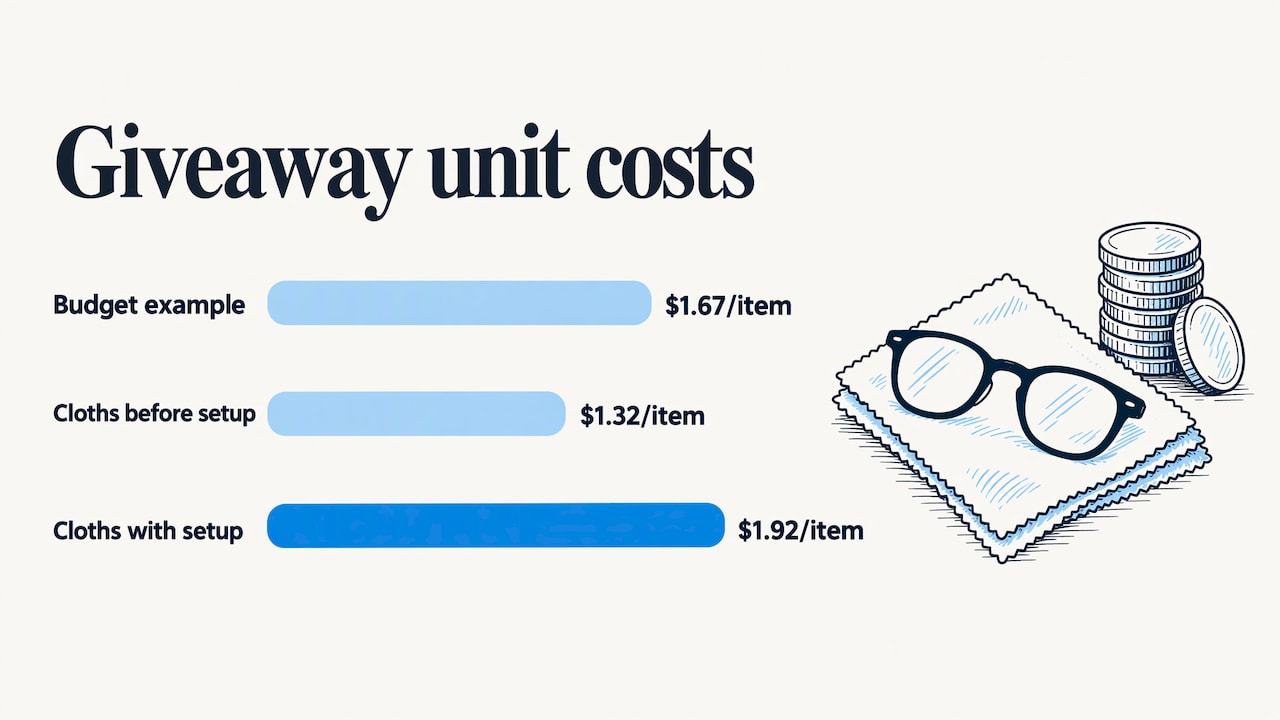
The most common mistake is ordering against total attendance. Your booth sees a fraction of the crowd. Exhibitor Online’s Promo Primer suggests working backward: divide your total giveaway budget by expected recipients to find an affordable unit cost. Its example is $5,000 for about 3,000 booth visitors, roughly $1.67 per item. It also warns about setup fees: a $60 screen-printing charge raised the price of 100 eyeglass cloths from $1.32 to $1.92 each.
A workable approach:
- Estimate booth visits from past shows or from your booth location and the show’s attendance.
- Split the plan by tier. Many visitors will take a low-cost item, fewer will complete your questions, and only a handful will earn a premium gift.
- Count meetings you have already booked separately, and add a reserve.
- Compare total delivered cost, including setup, shipping and minimum orders, not just the headline unit price.
Prize-based capture helps here. A prize wheel with a few premium prizes and many small ones lets you reward qualified visitors without buying 1,000 premium items. Because standalone booth giveaway tools run at a flat starting price per event with unlimited scans and leads, a busy day does not raise your capture cost.
Measuring whether your giveaways worked
Counting items handed out tells you what you spent, not what you gained. Makai, a consultancy that works on trade show incentives, argues that badge scan volume alone gives a misleading picture and recommends tracking both early indicators, such as qualified interaction rate, and later ones, such as opportunities created within 90 days.
The WABA guide lists activity metrics (booth conversations, qualified leads, appointments, QR scans, email signups) and business metrics (quotes requested, proposals sent, revenue influenced, cost per qualified lead). Compare them with the goals you set before the show.
A simple version for a small team:
- Cost per qualified lead: total giveaway spend divided by the leads your questions scored as hot or warm.
- Booth traffic: how many people scanned at all.
- Follow-up rate: how many leads you contacted within a few days.
- Pipeline: meetings and opportunities that came from the show.
When you present results internally, link them to revenue. Resources on content engagement strategies can help you think about tracking the business impact of promotional merchandise at technology events. Then act on the list quickly: our guide on what to do with trade show leads after the show covers the first week.
Career fairs: capture candidates and build booth traffic
Recruiters face the same problem: a crowded room, many conversations and little data. The same booth giveaway flow works for candidate capture. Students scan, answer your screening questions (major, graduation date, roles of interest) and spin the wheel or enter the drawing, which also pulls steady traffic to your table. See the career fair giveaway and QR lead capture page for how recruiting teams use it.
Our perspective
We have supported event organizers since 2004, and the pattern is consistent: a giveaway pays off when it is part of the lead process, not a separate gesture.
Exhibitors often spend most of their giveaway budget on the item and almost none on what the item is supposed to collect. The better question is what you want to know about a visitor before they walk away. Once you know that, the prize becomes the reason they answer.
That is why our booth giveaway tools put the questions first. A visitor scans, answers your qualifying questions, then spins the Instant Prize Wheel or enters the live Winner Drawing. Your team leaves with leads that are already sorted and ready to export, instead of a bowl of cards.
And because exhibitors work inside events that organizers run, we built the booth tools to sit alongside lead retrieval, booth maps and registration, with hands-on implementation support when an event needs it.
Droshawn
Run your booth giveaway with rsvpBOOK
If you are an exhibitor, start with the booth giveaway tools: a QR scan, your own qualifying questions, an Instant Prize Wheel or live Winner Drawing, and exportable leads. Standalone tools start at $99 for a single event.
If you organize the show, rsvpBOOK also offers lead retrieval for exhibitors, interactive booth maps and registration in one system. Pricing is per registration, with discounted rates for nonprofits and government organizations. Badge printing and check-in kiosk hardware are optional add-on rentals. Compare the options on the pricing page.
FAQ
What are the best trade show giveaways under $5?
Pens, notebooks, snack packs, mints, lip balm and cable organizers are the usual choices at this level. Food gifts scored well in the ASI impressions data, so wrapped candy is a safe pick. Use these for traffic, and keep better items for visitors who answer your questions.
How do I get leads from a giveaway instead of just handing out swag?
Make the exchange explicit. Ask visitors to scan a QR code, answer a few qualifying questions and then claim a prize or enter a drawing. That gives you contact details plus the context you need to prioritize follow-up.
Should I use a prize wheel or a drawing?
Use a wheel when you want instant action and a lively booth. Use a live drawing when you want visitors to return at a set time. rsvpBOOK supports both, the Instant Prize Wheel and the live Winner Drawing, with multiple prizes and quantities.
How many giveaways should I bring?
Base the number on expected booth conversations rather than total show attendance. Plan by tier, count booked meetings separately and add a reserve. Many guides suggest preparing items for a fraction of total attendance, with premium gifts for a small share of visitors.
How much does the rsvpBOOK booth giveaway tool cost?
Standalone booth giveaway tools start at $99 for a single event, with unlimited scans and leads.
Sources
- Trade Show Swag Ideas 2026 by Price
- Swag Marketing Statistics
- Swag That Works: The New Rules for Trade Show Giveaways
- Band-Aids and Brand Love: The Trade Show Survival Kit
- WABA Home Show Exhibitor Marketing & Booth Success Guide
- Promo Primer, Exhibitor Online
- Trade Show Offers and Incentives: A Strategic Guide
- Top Content Engagement Strategies for Business Growth
Ready to turn booth visits into qualified leads? Book a demo or start building an event free.
Recommended
- How to Choose Trade Show Booth Giveaways That Generate Leads
- Trade Show Lead Generation: A Practical Playbook for Exhibitors
- Trade Show Giveaway, Prize Wheel & Winner Drawing
- Lead Capture Apps for Trade Shows: How to Choose in 2026
Planning an event that doesn’t fit neatly into somebody else’s template? See how rsvpBOOK handles registration, onsite check-in, lead retrieval and engagement in one platform. Book a demo: https://www.rsvpbook.com/book-a-demo