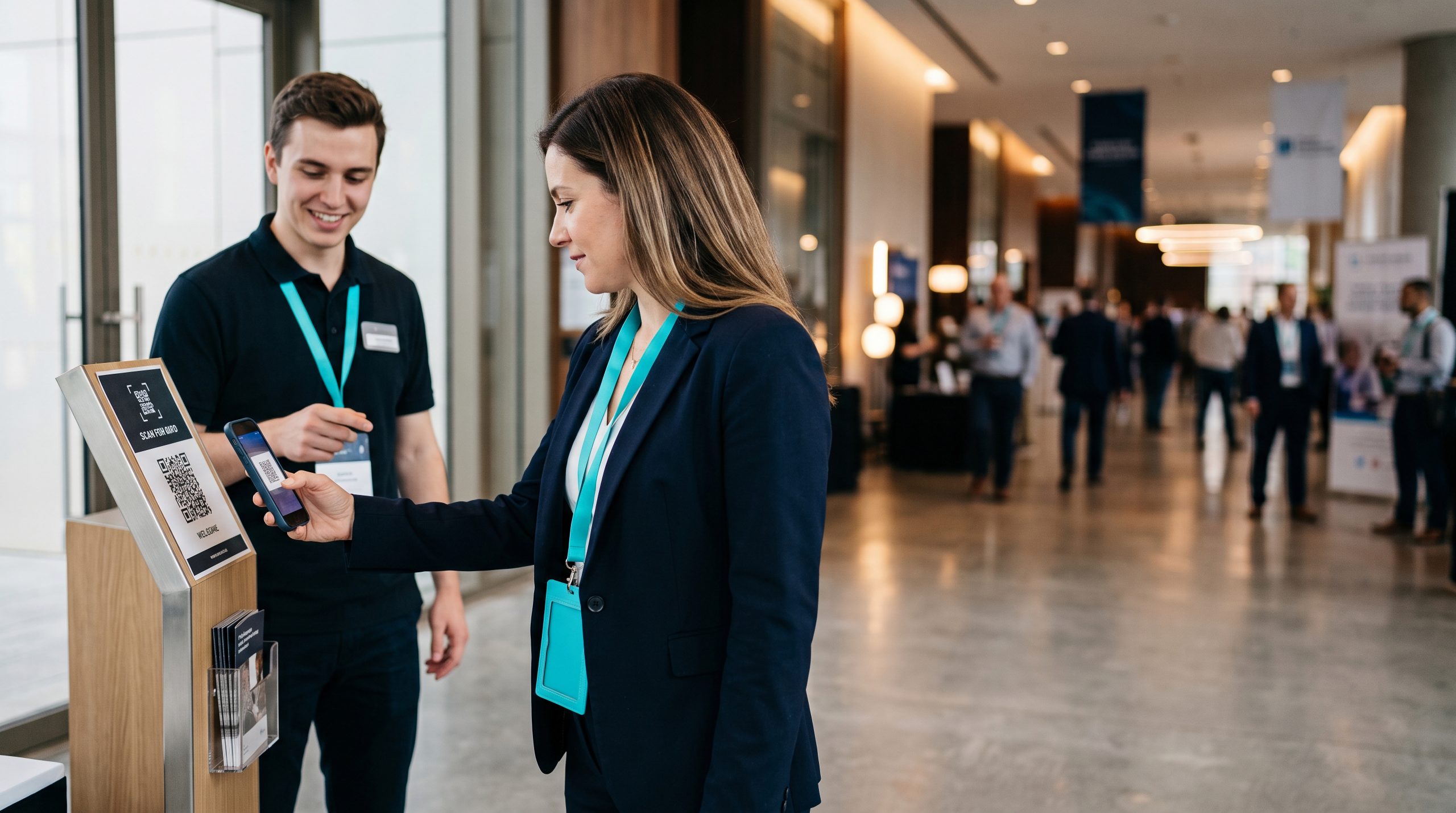
The best lead retrieval app for a trade show is one that scans the attendee’s event badge, asks your qualifying questions, saves your notes and gives you lead data you can export. Free business-card scanner apps only read printed cards. They don’t connect to the event’s registration data and they don’t qualify anyone. Event lead retrieval depends on attendees wearing a scannable QR badge, so the organizer’s registration setup matters as much as the app. rsvpBOOK offers lead retrieval for exhibitors and for organizers, plus booth giveaways (an Instant Prize Wheel or a live Winner Drawing) as a standalone lead capture option starting at $99 per event that works on visitors’ own phones.
TL;DR
- Badge-based lead retrieval beats a free card scanner when you need qualified, exportable leads tied to registration data. It only works if attendees carry a scannable QR badge.
- Three approaches cover most booths: card scanner apps, badge lead retrieval, and giveaway-driven capture on visitors’ own phones.
- rsvpBOOK covers the second and third, for exhibitors and organizers. Standalone booth giveaway tools start at $99 per event.
- Pick by who owns the badge, how you qualify leads, and how fast you can follow up.
- rsvpBOOK pricing is per registration, with discounted rates for nonprofits and government.
Table of Contents
- What a trade show lead capture app actually does
- The three kinds of options exhibitors choose from
- Badge-based lead retrieval: the qualified-lead option
- Giveaway-driven capture: lead generation on visitors’ own phones
- Card scanner apps: where they fit
- How to choose: six questions to answer before you commit
- Making the leads count after the show
- Which option fits which reader
- Our view: lead capture starts at registration
- Plan your lead capture with rsvpBOOK
- FAQ
- Sources
What a trade show lead capture app actually does
A lead capture app records who stopped at your booth and what they care about. That sounds simple. The difference between a useful app and a pile of contact names is what gets saved with each person.
A good record answers four questions:
- Who is this? Name, company, title and contact details, ideally from the attendee’s registration rather than from a hurried typing job.
- What do they need? Answers to qualifying questions you set in advance, such as budget range, timeline or product interest.
- What did you talk about? A short note that your team can read two weeks later.
- What should happen next? A rating or tag so sales knows who to call first.
People often use “lead capture” and “lead retrieval” interchangeably. In practice, lead retrieval usually means scanning the attendee’s badge so their registration details come back to the exhibitor. Lead capture is the wider idea: any way of collecting a lead at the booth, including card scans, forms, giveaways and badge scans.
The three kinds of options exhibitors choose from
Most apps you will find fall into one of three types. Here they are side by side.
| Free card scanner app | Badge-based lead retrieval | Giveaway-driven capture | |
|---|---|---|---|
| What you scan | A printed business card | The QR code on the attendee’s event badge | Nothing: visitors use their own phone |
| Where the data comes from | Text read from a card photo | The attendee’s registration record | What the visitor enters to play or enter |
| Custom qualifying questions | Rarely | Yes, set per exhibitor or event | Entry fields you choose |
| Notes at the booth | Sometimes | Yes | Not the focus |
| Depends on the organizer | No | Yes, badges must carry a scannable QR code | No |
| Best for | Quick contact swaps | Qualified leads at organized shows | Booth traffic and opt-in contacts |
| rsvpBOOK option | n/a | Lead retrieval | Booth giveaways |
None of these is a one-size answer. Many exhibitors combine badge scanning for serious conversations with a giveaway that pulls in walk-by traffic.
Badge-based lead retrieval: the qualified-lead option
Badge lead retrieval is the approach built for trade shows. The exhibitor’s staff scan the QR code on an attendee’s badge, the lead’s details come in, and the rep answers a few qualifying questions and adds a note before the person walks away.
Three things make it stronger than a card scanner:
- Accuracy. The contact information comes from registration, so nobody is squinting at a blurry card.
- Qualification. Custom questions turn a name into a lead you can sort.
- Speed to export. Lead data can be exported in real time, so follow-up doesn’t wait for a spreadsheet cleanup.
The catch is simple. It only works when the badge carries a scannable QR code and the organizer has set up lead retrieval for the show. An exhibitor can’t always fix that alone. If you’re an exhibitor, ask the show organizer early which badge format will be used and how lead retrieval will be offered to exhibitors. If you’re an organizer, this is a registration decision, not a booth decision.
What rsvpBOOK lead retrieval offers exhibitors
rsvpBOOK lead retrieval gives exhibitors a way to scan attendee badges at the booth, capture qualifying answers and notes, and work with real-time exportable lead data. Because rsvpBOOK connects registration, onsite operations, exhibitor programs and reporting in one record, the badge a visitor wears and the lead an exhibitor collects come from the same system.
What rsvpBOOK lead retrieval offers organizers
Organizers decide how exhibitors get lead retrieval and what control they keep over it. rsvpBOOK has a dedicated page on lead retrieval for event organizers covering packages and control. It fits naturally with the rest of a show: interactive booth maps with booth sales, exhibitor programs and custom reports, all in the same event record.
rsvpBOOK has supported event organizers since 2004. It is positioned as a flexible alternative to enterprise event platforms: configurable for complex events, but built so a planner can set up a show without a heavy implementation. Teams can set up on their own or ask for hands-on implementation support.
Giveaway-driven capture: lead generation on visitors’ own phones
Not every booth conversation starts with a badge scan. Some visitors drift past, some haven’t registered through the organizer, and some booths simply need more foot traffic. That’s where a giveaway helps.
rsvpBOOK booth giveaway tools come in two formats:
- Instant Prize Wheel: a visitor enters, spins and finds out right away. It makes a good draw for a busy aisle.
- Winner Drawing: a live drawing that gives you a reason to bring people back to the booth at a set time.
Both work on visitors’ own phones. Visitors scan a code and enter, so you don’t hand out devices or collect paper slips. Standalone booth giveaway tools start at $99 per event, and you can run them without a full event management setup.
Visitors’ phones already read QR codes through the built-in camera, as Apple’s support page explains for iPhone and iPad. That means a sign with a code on your table is usually all a visitor needs to join in.
A giveaway works best when it is tied to a purpose. Offer a prize related to your product, ask for the details your sales team needs, and keep the entry short. The same approach suits recruiters at career fairs, where candidate capture and booth traffic matter more than product demos.
Card scanner apps: where they fit
Free business-card scanner apps read a printed card and save the contact. They are a reasonable fit for casual networking, where you swap cards at a small meetup and want them in your phone.
At a trade show with hundreds of conversations, you usually need more: a standard set of questions across your whole team, notes tied to each contact, and data that exports cleanly for sales. That is the gap event lead retrieval fills.
How to choose: six questions to answer before you commit
Use these to compare any option, including rsvpBOOK.
1. Who controls the badge?
If the organizer issues badges with a scannable QR code, badge scanning is on the table. If badges carry only a name, you need another way to capture the lead. Ask the organizer which it is, and whether the badge’s QR code can be used for lead retrieval or is meant only for check-in.
2. Can you set your own qualifying questions?
A lead with no context is hard to prioritize. Look for custom questions, notes and a simple rating so your team collects the same details from every conversation.
3. How does the data leave the app?
Ask how leads are exported and how quickly. Real-time exportable lead data means your sales team can see leads during the show, not a week after it.
4. How many people will scan?
A booth with two reps has different needs from a sponsor floor with ten. Check how many scanning users a package covers and what extra users cost.
5. What happens to attendee data?
Attendees share their details to get into an event, so confirm what an exhibitor receives and how it may be used. Keep your follow-up inside the rules: for email, the FTC’s CAN-SPAM compliance guide sets out what commercial messages must include, such as a way to opt out.
6. What does the full event cost?
Pricing varies by provider and by module, so look past the headline number. For rsvpBOOK, pricing is per registration, with discounted rates for nonprofits and government. Lead retrieval, booth giveaways, gamification, SMS messaging and QR code management are separate modules. Standalone booth giveaway tools start at $99 per event. Badge printing and check-in kiosk hardware are optional add-on rentals, so plan for them separately when you budget the show.
Making the leads count after the show
The app gets the lead into your hands. The follow-up turns it into a conversation. Three habits help:
- Sort on day one. Use the ratings or tags from the booth to split hot leads from general interest.
- Send something useful within a few days. A short, relevant message beats a generic blast. For ideas on what to send, content for lead generation is a good place to start.
- Give each lead an owner. One person, one next step, one date.
For a deeper look, rsvpBOOK’s blog covers what to do with trade show leads after the show, a practical playbook for trade show lead generation, and badge scanners versus digital tools.
Which option fits which reader
Exhibitors and sponsors who want qualified leads from organized shows should look first at badge-based lead retrieval. Add a booth giveaway when you want more traffic and a reason for people to stop.
Trade show organizers and association planners can offer lead retrieval to exhibitors as part of the show, alongside booth maps, booth sales and reporting. One registration record keeps badges, exhibitor programs and lead data in step.
Campus recruiters and career fair hosts care about candidate capture and booth traffic. A prize wheel or winner drawing draws students to the table, and scanning gives recruiters a fast way to record who they met.
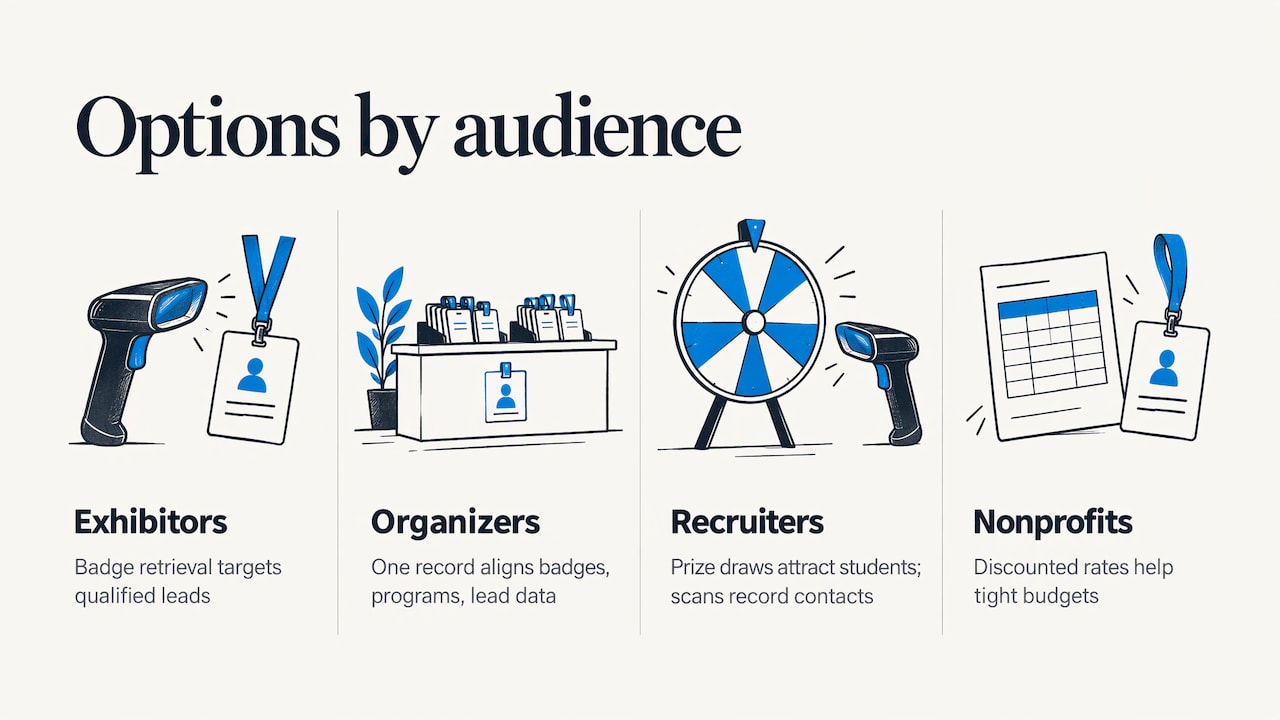
Nonprofits and government teams can use the discounted rates rsvpBOOK offers, which helps when the budget is tight.
Our view: lead capture starts at registration
Most lead capture problems at trade shows begin before the doors open. If the badge isn’t scannable, the exhibitor falls back on handwriting and photographed business cards, and the lead record is only as good as the typing.
That is why we build lead retrieval on the same record as registration, check-in and exhibitor programs. The attendee registers once, wears a badge with a QR code, and the exhibitor scans it. Organizers keep control of how lead retrieval is offered, and exhibitors get qualified data they can export.
For booths that need more traffic, our Instant Prize Wheel and Winner Drawing work on visitors’ own phones and start at $99 per event as standalone tools. We have supported event organizers since 2004, and when an event needs more than self-service setup, our team provides hands-on implementation support.
Droshawn
Plan your lead capture with rsvpBOOK
If you run a show, rsvpBOOK brings registration, badges, exhibitor lead retrieval, booth maps and reporting into one event record. If you exhibit, lead retrieval and booth giveaways give your team a structured way to capture and qualify leads.
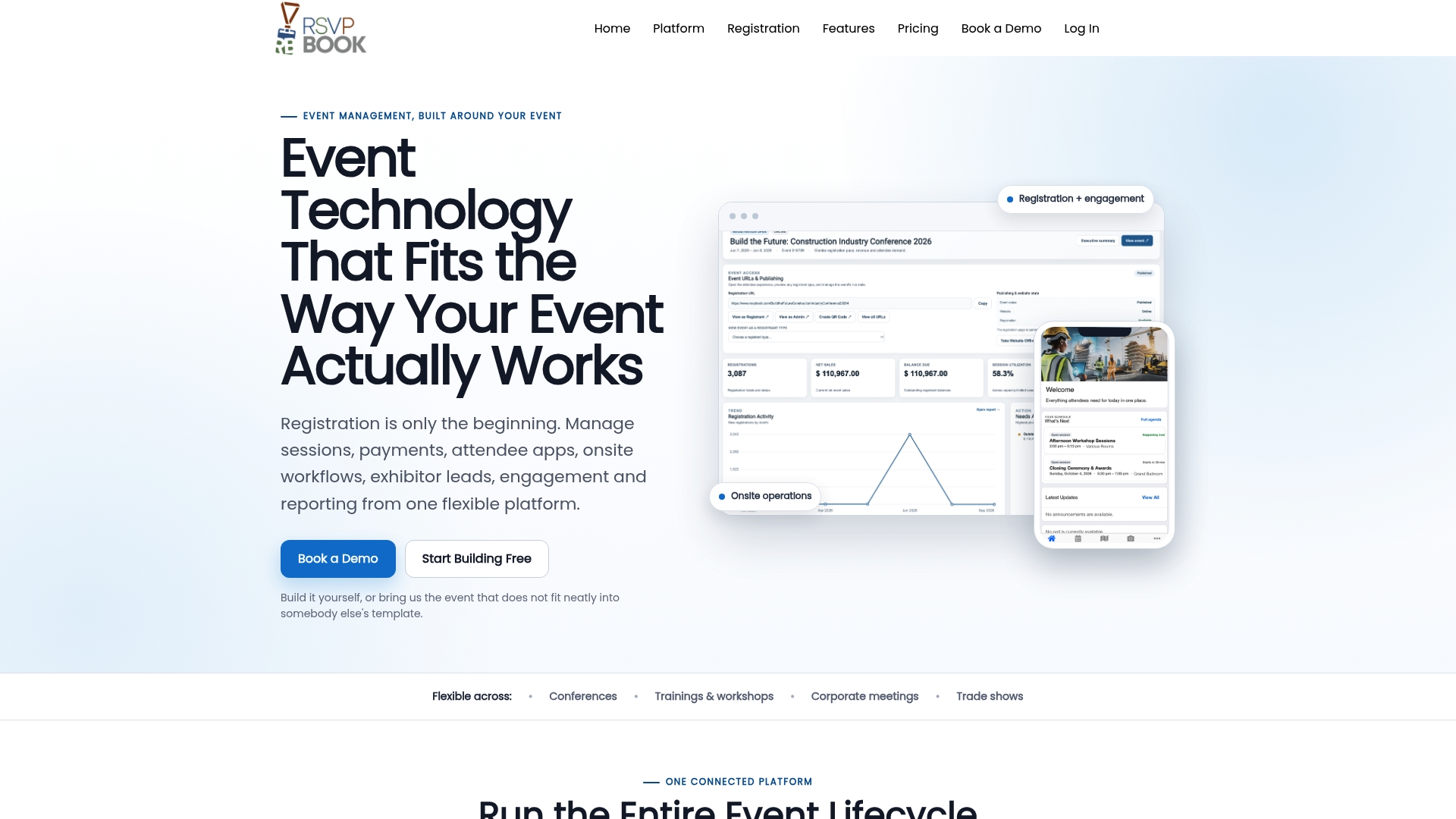
Pricing is per registration, with discounted rates for nonprofits and government. Badge printing and Kiosk+ check-in hardware are optional add-on rentals. See the features overview for the full toolkit.
FAQ
Is there a free lead capture app for trade shows?
Free business-card scanner apps exist, and they save contacts from printed cards. They don’t scan event badges or collect custom qualifying answers. If you need qualified leads with exportable data, event lead retrieval is built for that job. rsvpBOOK lead retrieval is not a free tool, though attendee QR check-in is free on any smartphone.
What is the difference between lead capture and lead retrieval?
Lead capture is the broad term for collecting leads at a booth by any method. Lead retrieval usually means scanning an attendee’s badge to pull their registration details into your lead list. Retrieval is one way to do capture, and it adds accuracy and structure.
Do I need the organizer’s help to scan badges?
Yes. Badge scanning depends on the badge carrying a scannable QR code and on the organizer enabling lead retrieval for exhibitors. Ask the organizer early which badge format the show will use.
Can I capture leads without scanning badges?
Yes. A booth giveaway lets visitors enter on their own phones. rsvpBOOK’s Instant Prize Wheel and Winner Drawing start at $99 per event as standalone tools and bring in visitors who might otherwise walk by.
How does rsvpBOOK charge for events?
Pricing is per registration, with discounted rates for nonprofits and government. Specialized modules such as lead retrieval, gamification and SMS messaging are separate. Book a demo to talk through your event.
Sources
- Scan a QR code with your iPhone or iPad – Apple Support
- CAN-SPAM Act: A Compliance Guide for Business – Federal Trade Commission
- How to Use Content for Lead Generation Successfully
Ready to put this into practice? Book a demo or start building an event free.
Recommended
- Trade Show Lead Capture: Badge Scanners vs. Digital Tools
- What to Do With Trade Show Leads After the Show
- Trade Show Lead Generation: A Practical Playbook for Exhibitors
- Lead Retrieval Software for Trade Shows & Exhibitors
Planning an event that doesn’t fit neatly into somebody else’s template? See how rsvpBOOK handles registration, onsite check-in, lead retrieval and engagement in one platform. Book a demo: https://www.rsvpbook.com/book-a-demo